
Quality
Chain of Custody and Product Authentication
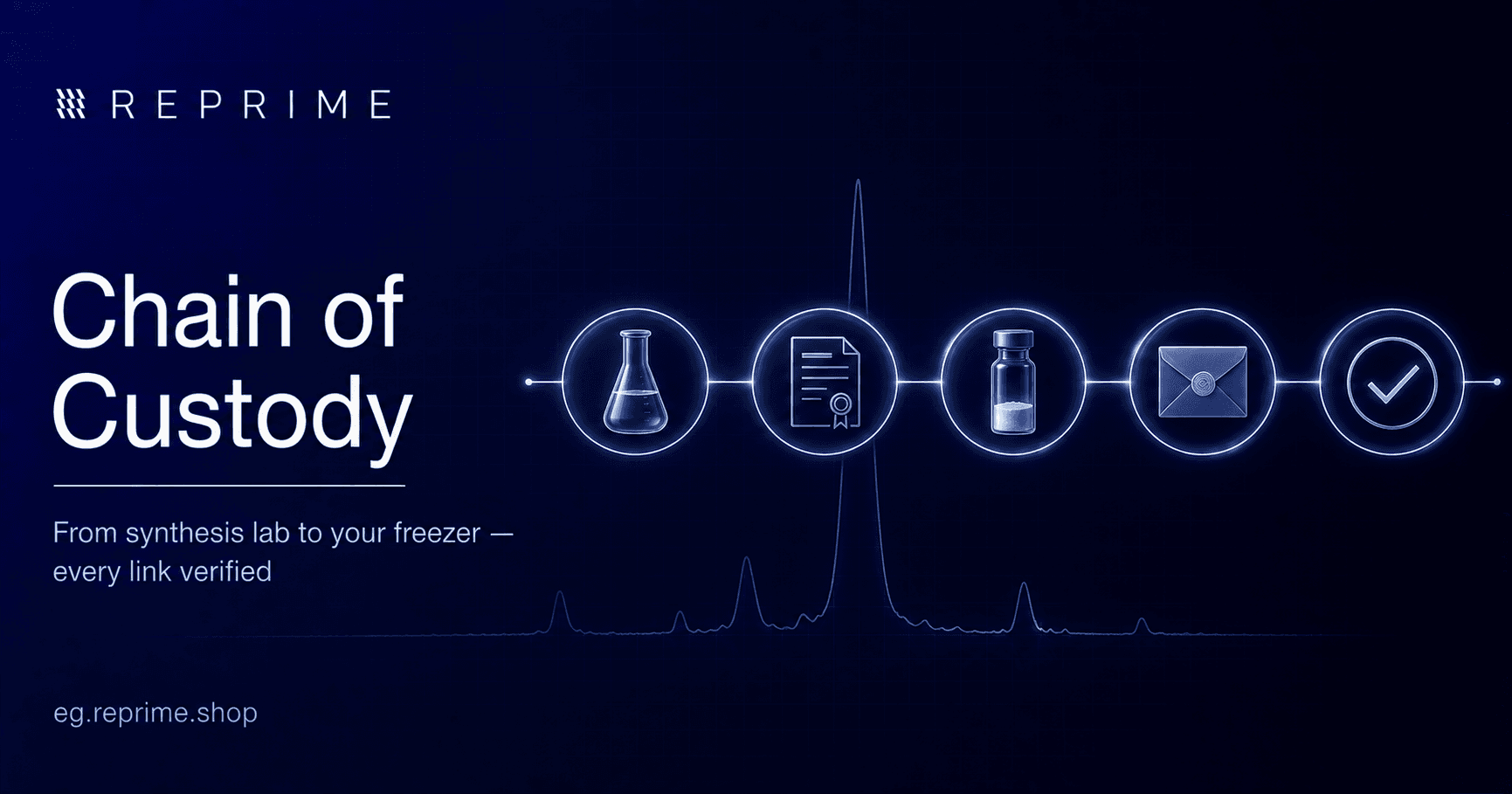
A research peptide passes through several hands between the synthesis lab and the customer's freezer. Here is REPRIME's full chain of custody and how every link is verified.
A research peptide passes through several hands between the synthesis lab and the customer's freezer. At each handoff there is an opportunity for the wrong vial to end up in the wrong package, or for a vial to be substituted with something cheaper. REPRIME's chain-of-custody protocols are designed to make those substitutions detectable.
The chain
Each REPRIME vial moves through a defined sequence:
- Synthesis — solid-phase peptide synthesis at the contract manufacturer
- Quality testing — third-party laboratory runs HPLC, MS, sterility, and endotoxin tests; issues a batch-specific COA
- Lyophilization — peptide is freeze-dried into the vial
- Vial sealing and labeling — vial gets a printed label with the batch number
- Verification-code printing — package insert is printed with a unique code linked to the batch
- Package assembly — vial plus insert plus tamper-evident seal
- Cold-chain dispatch — insulated envelope with phase-change gel
- Courier delivery — to the customer's address
- Customer verification — code scanned at /verify on first use
Each step is logged. The verification code links to the batch number; the batch number links to the COA; the COA links to the test results.
What the verification code proves
When a customer scans a code on /verify, the system confirms:
- The code was issued by REPRIME (it is in our database)
- It has not been verified before — or, if it has, exactly when
- Which batch it belongs to
- Which product and vial size it corresponds to
- The current expiry date for that batch
If the code is unknown, the system says so. If the code has been scanned before, the customer is warned. The warning is the anti-counterfeit signal, not a failure.
Why repeat scans matter
A genuine REPRIME vial has one code, one customer, one first scan. If a code has been scanned before the customer's first attempt, one of two things has happened:
- The customer tested it earlier and forgot — fine, the warning is informational
- The package was opened, the code copied, and the package re-sealed with a counterfeit vial — the warning is the signal you needed
REPRIME treats every repeat scan as a customer-support contact opportunity. If you see 'Already verified' and you did not scan it yourself, message us on WhatsApp at +20 100 444 3373.
What we publish and what we do not
REPRIME publishes:
- COA for every batch in the Certificates repository
- HPLC chromatogram for every batch
- MS identity confirmation for every batch
- Batch numbers on product pages
- Verification system at /verify
We do not publish:
- Customer information
- Internal QC failure rates (we publish what we shipped, not what we rejected)
- Code lists (codes are one-time tokens, not bulk-disclosable)
What you can do
For every vial you buy, scan the code on first use. Save the COA. If a vial's purity drops over time on re-analysis, you have the paper trail to investigate. The system works because everyone uses it.
See also Why Product Verification Matters and Reading a Certificate of Analysis.