
Science
Tirzepatide vs Retatrutide
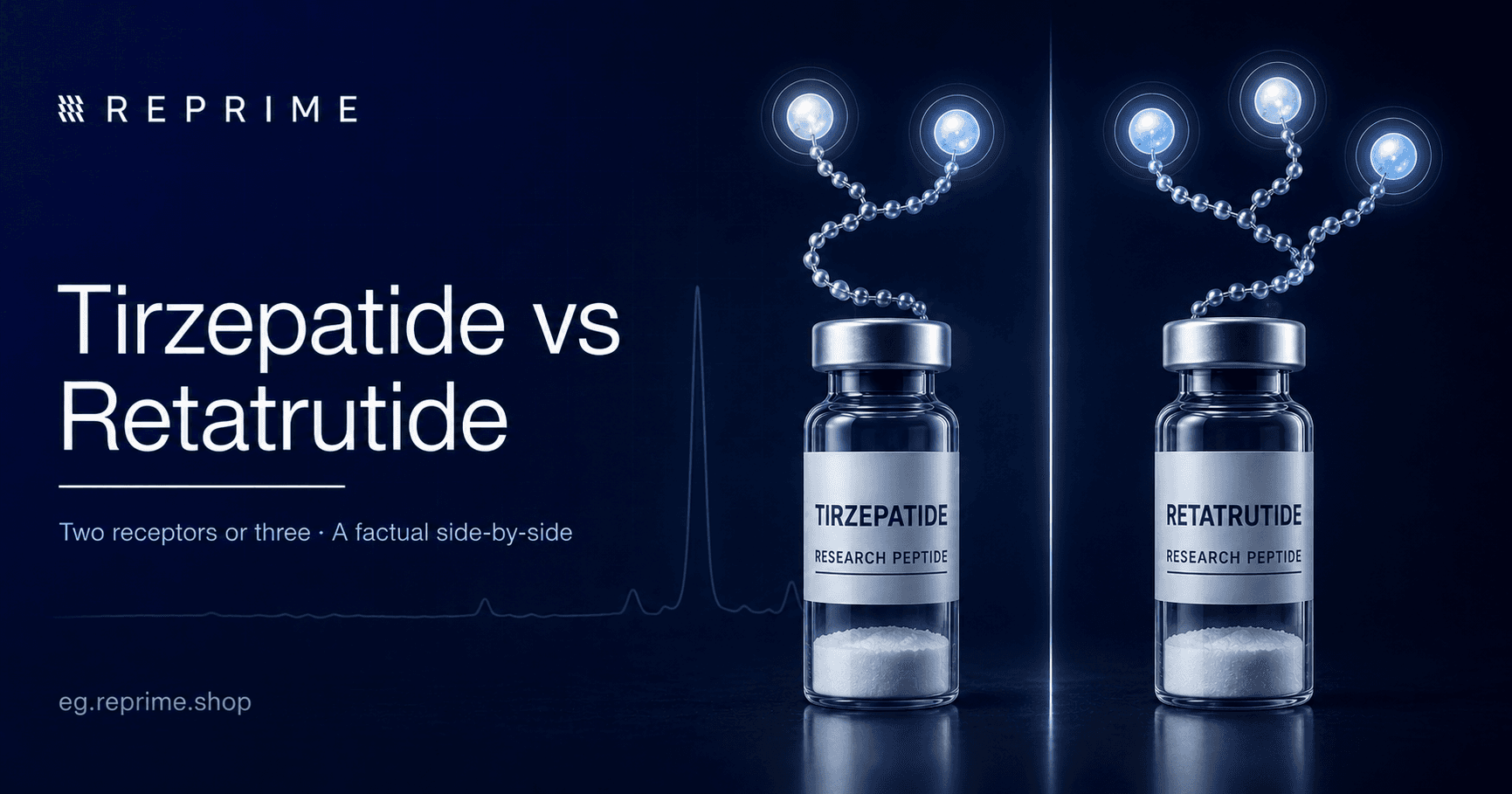
Tirzepatide (two receptors, approved) vs retatrutide (three, investigational): a factual side-by-side of design, mechanism, trial evidence, and research use.
Tirzepatide and retatrutide are closely related engineered peptides from the same research lineage at Eli Lilly, and they are compared constantly — usually loosely. The factual core: tirzepatide activates two metabolic receptors (GIP and GLP-1) and is an approved medicine in many jurisdictions, while retatrutide activates three (GIP, GLP-1, and glucagon) and remains investigational as of August 2026. This page compares the two molecules dimension by dimension for readers working with research-grade material.
The short answer
Tirzepatide is a dual GIP/GLP-1 receptor agonist, first described in 2018 and approved as a medicine since 2022 (Mounjaro, Zepbound). Retatrutide is a triple GIP/GLP-1/glucagon receptor agonist, first described in 2022, with phase 3 trials reporting through 2025–2026 and no marketing approval yet. Both are single peptides built on a GIP-derived backbone with a C20 fatty-diacid modification that supports once-weekly administration in trials.
Side-by-side comparison
| Dimension | Tirzepatide | Retatrutide |
|---|---|---|
| Development code | LY3298176 (Eli Lilly) | LY3437943 (Eli Lilly) |
| Receptor targets | GIP + GLP-1 (dual agonist) | GIP + GLP-1 + glucagon (triple agonist) |
| Molecular design | 39-amino-acid GIP-derived backbone, C20 fatty-diacid acylation | GIP-derived backbone with non-natural residues, C20 fatty-diacid acylation |
| Dosing profile in trials | Once weekly | Once weekly |
| First characterized | Molecular Metabolism, 2018 | Cell Metabolism, 202200312-6) |
| Regulatory status (Aug 2026) | Approved medicine: Mounjaro (2022), Zepbound (2023) | Investigational — no marketing approval |
| Clinical evidence stage | Phase 3 programs published (SURPASS, SURMOUNT) | Phase 3 topline results 2025–2026; first phase 3 publication 2026 |
| Research-grade form at REPRIME | Tirzepatide, lyophilized | Retatrutide, lyophilized |
What they share
Both molecules come from the same design philosophy: start from the GIP sequence, engineer in activity at additional receptors, and acylate with a C20 fatty diacid so the peptide binds serum albumin and survives long enough for once-weekly dosing in trials. Both are single peptides — not mixtures — and both are studied in metabolic research: incretin signaling, glycemic regulation, and body-weight biology. As research material, both ship as lyophilized powder, store at -20°C, and carry batch-specific identity and purity documentation.
Where they differ
The defining difference is the glucagon receptor. Tirzepatide engages the two incretin receptors; retatrutide adds glucagon-receptor agonism on top. In the literature, the glucagon component is associated with hepatic effects and increased energy expenditure — one reason retatrutide has been studied in liver-focused contexts (see the MASLD trial below) alongside obesity and diabetes.
The second difference is maturity. Tirzepatide's evidence base is an approved-medicine dossier: completed, published phase 3 programs in type 2 diabetes (SURPASS) and obesity (SURMOUNT). Retatrutide's phase 3 program reported topline results across 2025–2026, with the first full publication appearing in 2026 — a substantial record for an investigational compound, but a younger one.
What the clinical literature reports
Reported as literature facts about the investigational or approved medicines — not claims about research material:
- Tirzepatide: in SURMOUNT-1, a 72-week phase 3 obesity trial, the highest dose reported a mean body-weight reduction of 20.9% (Jastreboff et al., NEJM, 2022).
- Retatrutide: in a 48-week phase 2 obesity trial, the highest dose reported a mean body-weight reduction of 24.2% (Jastreboff et al., NEJM, 2023).
Those two figures are quoted together constantly, and the comparison is not apples-to-apples: different trial phases, different durations (72 vs 48 weeks), and different populations. No published head-to-head trial of the two compounds exists that we are aware of. Treat cross-trial numbers as context, not as a ranking.
Which one belongs in your protocol?
For laboratory work the question is not which compound is "better" — it is which receptor footprint your experiment needs. A protocol probing dual incretin signaling wants the dual agonist; adding glucagon-receptor activity changes the experiment, which is precisely the point of choosing retatrutide. Protocols that need to attribute effects to specific receptors typically pair either compound with selective single-agonist comparators.
Both are available research-grade from REPRIME as lyophilized powder with published, batch-specific COAs — see What Is Tirzepatide? and What Is Retatrutide? for each molecule's full explainer, and Reading a Certificate of Analysis for how to check the documents.
Frequently asked questions
Are tirzepatide and retatrutide the same molecule?
No. They are distinct engineered peptides. Tirzepatide (LY3298176) activates the GIP and GLP-1 receptors; retatrutide (LY3437943) activates those two plus the glucagon receptor. They share a design lineage but differ in sequence, receptor profile, and regulatory status.
Is retatrutide an approved medicine like tirzepatide?
No. Tirzepatide has been approved as a medicine since 2022 (Mounjaro for type 2 diabetes, later Zepbound for chronic weight management). Retatrutide remains investigational as of August 2026: phase 3 topline results have been reported, but no regulatory approval has been granted.
Is retatrutide "stronger" than tirzepatide?
The published trials measured different things over different durations in different populations, and no head-to-head trial of the two has been published that we are aware of. Cross-trial percentages are context, not a ranking — see the evidence section above for the actual figures and their limits.
Does REPRIME sell both as research material?
Yes — tirzepatide and retatrutide are both available as research-grade lyophilized powder, each with mass-spectrometry identity confirmation, an HPLC purity report, and a package verification code checked at /verify. Research use only; REPRIME provides no dosage or protocol guidance.
References
- Coskun et al. — LY3298176, a novel dual GIP and GLP-1 receptor agonist: from discovery to clinical proof of concept — Molecular Metabolism (2018)
- Coskun et al. — LY3437943, a novel triple glucagon, GIP, and GLP-1 receptor agonist: from discovery to clinical proof of concept — Cell Metabolism (2022)00312-6)
- Jastreboff et al. — Tirzepatide Once Weekly for the Treatment of Obesity (SURMOUNT-1) — New England Journal of Medicine (2022)
- Jastreboff et al. — Triple-Hormone-Receptor Agonist Retatrutide for Obesity — New England Journal of Medicine (2023)
- Zepbound (tirzepatide) FDA approval history — Drugs.com