
Quality
Reading a Certificate of Analysis
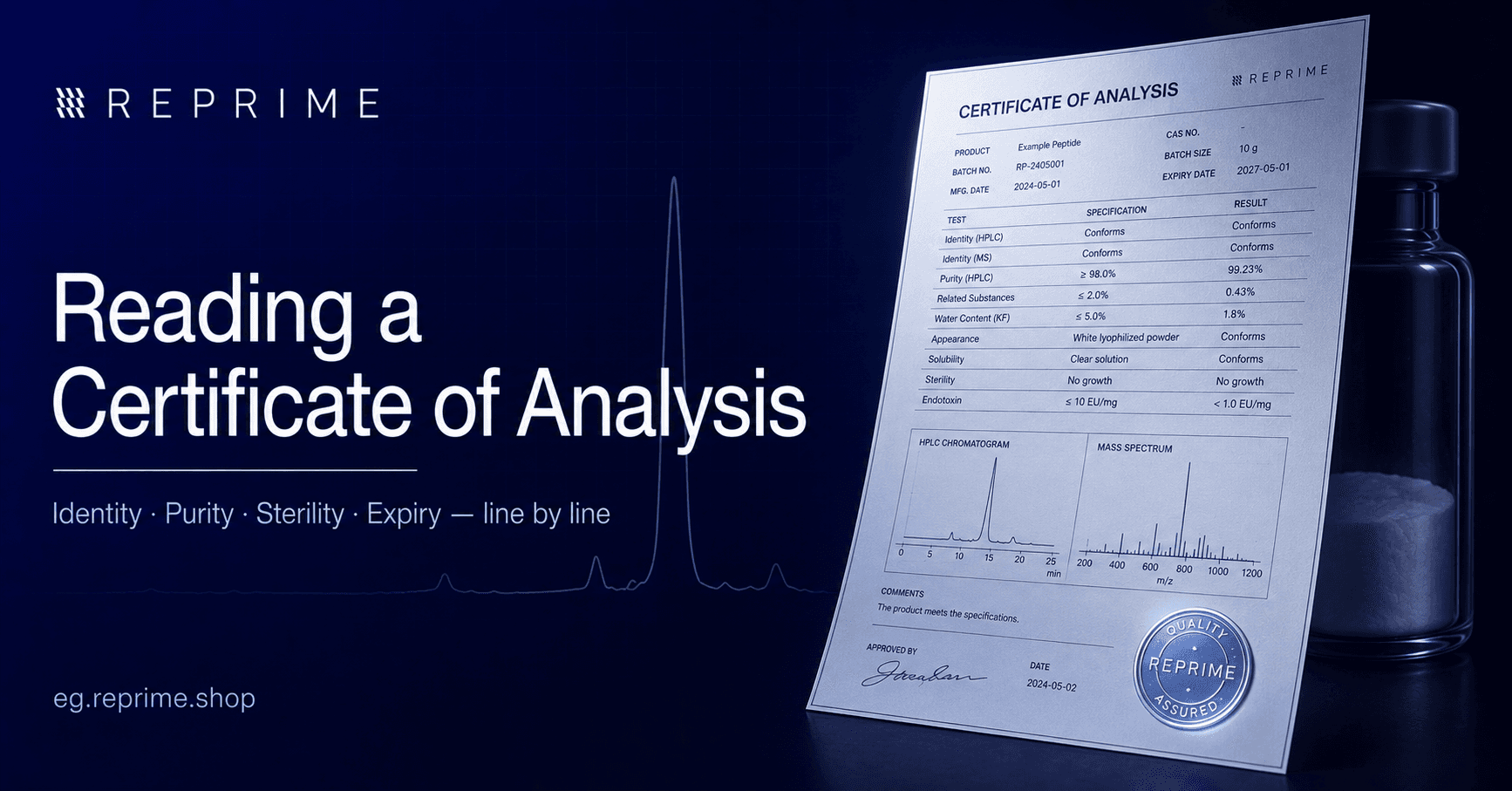
Every REPRIME vial ships with a COA in the public Certificates repository. The document is detailed, sometimes intimidating, and the information matters. Here is how to read one.
Every REPRIME vial is paired with a Certificate of Analysis (COA) published openly in our Certificates repository. The document is detailed — sometimes intimidating to a first-time reader — and the information matters. This article walks through a real COA line by line so you know what to look for and what each section actually tells you.
The header block
The top of a REPRIME COA shows:
- Product name — the compound and vial size (e.g. 'Retatrutide 20 mg')
- Batch number — the unique identifier for this manufacturing lot
- Date of analysis — when the testing was completed
- Issuing laboratory — the independent third-party lab that performed the analysis
- Date of expiry — based on stability testing for the lyophilized form
If any of these fields are missing from a COA you are shown anywhere — by us or anyone else — that is a red flag. Genuine documents include every header field; missing entries are usually a sign of a fabricated or partial COA.
Identity confirmation
The identity section confirms the molecule is what the label says. REPRIME uses two complementary methods:
- Mass spectrometry (MS) — measures the molecular weight of the compound and compares against the theoretical mass of the target peptide. A pass is typically within 1 Da of expected. The COA shows both the experimental value and the theoretical value side by side. If they differ meaningfully, the identity is in question regardless of how pure the sample is. For more, see Understanding Mass Spectrometry.
- Amino acid analysis (AAA) — quantifies each amino acid residue in the molecule and compares against the expected sequence composition. The COA shows the AAA composition table next to the theoretical composition. Discrepancies often reveal racemization or deletion peptides that mass spectrometry alone will not catch.
Both methods together establish identity rigorously.
Purity quantification
The purity section is where the HPLC chromatogram lives, plus its area-under-curve calculations. You will see:
- A trace with peaks plotted against retention time
- The main peak identified as the target peptide, usually annotated
- Smaller peaks identified as related substances or impurities
- The purity percentage — what that figure means: the area of the main peak divided by the total peak area
REPRIME's quality threshold is greater than 98% main-peak purity. Each product page shows the exact figure for the current batch — for example, Retatrutide 20 mg currently shows 99.20%.
Sterility and endotoxin
Lyophilized peptide for research use is tested for:
- Bioburden — bacterial contamination of the finished product
- Endotoxin — bacterial cell-wall fragments (lipopolysaccharide)
Both should be below documented limits. The COA shows the measured values; if either is at or above the limit, the batch is rejected and does not ship.
Storage and expiry
The COA specifies the recommended storage condition (-20°C lyophilized) and the expiry date based on stability data. Most lyophilized peptides at -20°C have a 2-year shelf life from the date of manufacture, but the COA shows the exact date for the specific batch.
How to use a COA
A COA is a verification tool, not marketing copy. Read the actual numbers. Compare them across batches over time — a manufacturer whose purity is drifting downward across batches is a manufacturer to watch carefully. If something looks off, ask. REPRIME's customer support is the right point of contact, and we will explain any line on any COA we issue.
For the related question of how the document fits into the broader chain of custody, see Chain of Custody and Product Authentication. Browse all certificates.