
Science
GHK-Cu: A Research Overview
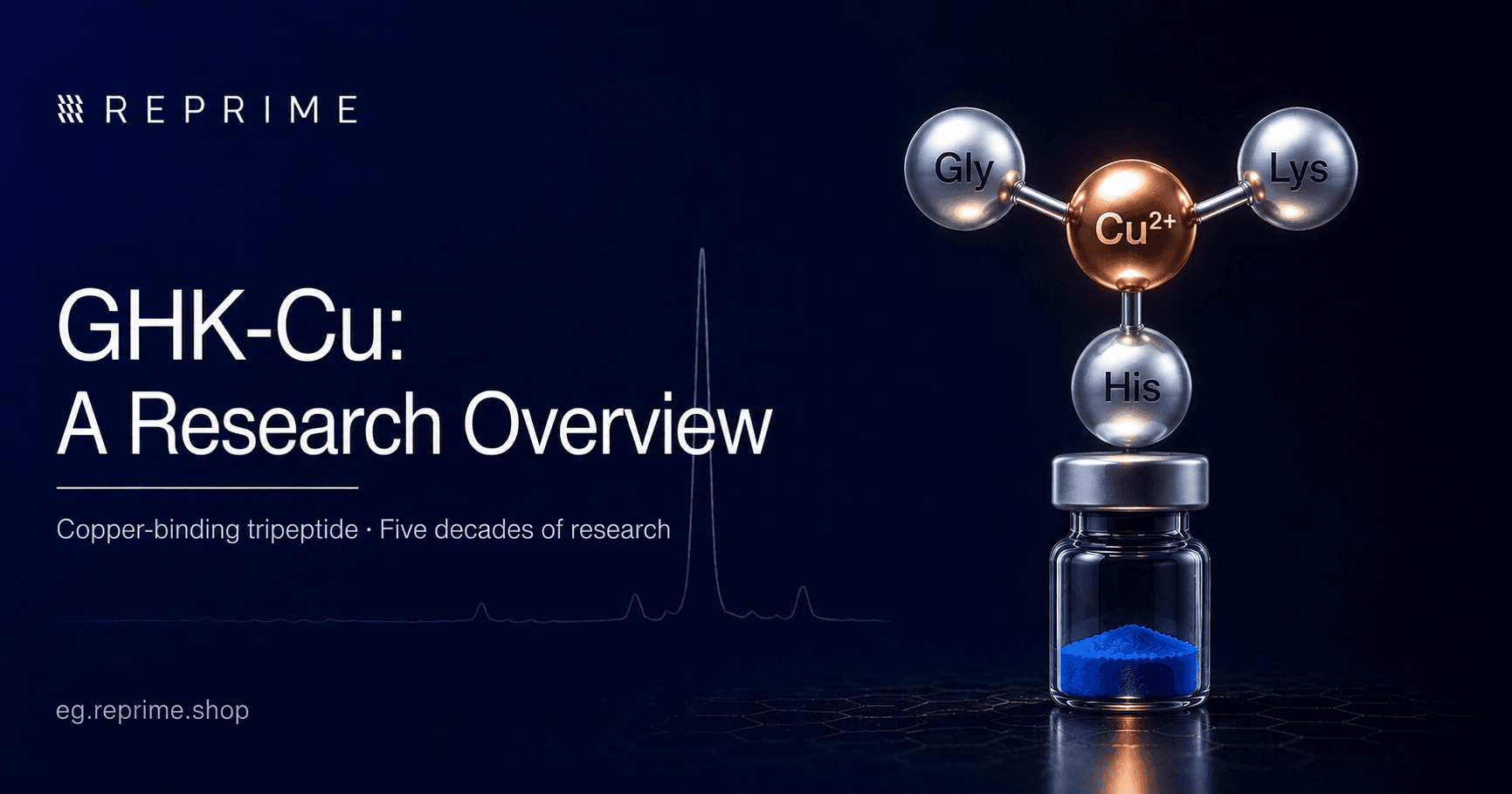
What the GHK-Cu copper-peptide complex is, how GHK and GHK-Cu differ, and what five decades of research actually shows — organized by evidence level.
GHK-Cu is a copper-binding peptide complex: the tripeptide glycyl-L-histidyl-L-lysine (GHK) coordinated to a copper(II) ion. First isolated from human plasma in 1973, it is one of the longest-studied molecules in peptide research — five decades of laboratory work spanning cell culture, animal models, and small human cosmetic studies. This overview explains what the complex is, how GHK and GHK-Cu differ, and what the research record actually contains, organized by evidence level. GHK-Cu at REPRIME is supplied as research-use material; nothing here is a claim about treatment.
What is GHK-Cu?
GHK is a peptide of just three amino acids — glycine, histidine, lysine — making it the smallest research peptide in the REPRIME catalog. It occurs naturally in human plasma, where Loren Pickart and Melvin Thaler first isolated it in 1973 while investigating why plasma from younger donors supported liver-cell function better than plasma from older donors (Pickart & Thaler, 1973; see References).
The histidine in GHK's sequence gives the tripeptide a high affinity for copper(II). In biological fluids and in preparation, GHK readily binds a copper ion to form the GHK-Cu complex — and the complex, not the bare tripeptide, is what most of the biological literature has studied.
GHK vs GHK-Cu: the terminology
The two names are used loosely in the literature and in catalogs, but they are not interchangeable:
- GHK is the free tripeptide (glycyl-L-histidyl-L-lysine).
- GHK-Cu is that tripeptide bound to copper in a defined complex — for a research preparation, the expected stoichiometry is one copper per peptide.
The distinction matters twice. When reading studies, it determines whether an observed effect belongs to the peptide, the copper, or the complex. When reading a product record, it determines what the material is: a pure GHK-Cu preparation maintains the 1:1 peptide-to-copper stoichiometry that researchers expect, and the composition belongs in the batch documentation.
Why the copper matters
Copper is a required cofactor for enzymes involved in connective-tissue biology and oxidative metabolism, but free copper ions are reactive and tightly managed by living systems. The interest in GHK-Cu is precisely that it is a small, defined peptide-copper package: as early as 1980 it was proposed that GHK's biological activity may involve facilitating copper uptake into cells (Nature, 1980) — a hypothesis, not a settled mechanism.
The evidence that the complex is more than a generic copper carrier comes from specificity controls: in the classic fibroblast experiments, an unrelated control tripeptide-copper complex was inactive where GHK-Cu was active, indicating the effect is sequence-dependent rather than a simple copper-delivery phenomenon (Maquart et al., 1988). The full mechanism remains an active research question.
What has GHK-Cu been studied for?
Organized by research area, with the evidence level stated plainly:
- Collagen and extracellular-matrix synthesis — in vitro. The most-cited finding: GHK-Cu stimulated collagen synthesis in cultured human fibroblasts at remarkably low concentrations, without changing cell number (Maquart et al., 1988). Related culture work extends to other matrix components.
- Wound-healing models — animal. GHK-Cu has been studied in animal wound models, including effects on matrix components in healing tissue. Animal findings do not automatically translate to humans.
- Gene-expression profiling — in vitro and computational. A 2018 review consolidates profiling data suggesting GHK modulates the expression of a large fraction of tested human genes, and frames the regenerative hypotheses built on that observation (Pickart & Margolina, 2018). Profiling describes association, not proven downstream function.
- Oxidative-stress biology — biochemical and in vitro. GHK has been proposed as an endogenous antioxidant, with laboratory evidence for radical-quenching behavior (see the 2018 antioxidant review in References).
- Skin research — small human cosmetic studies. Topical GHK-Cu has been examined in small cosmetic-context studies. These are limited in size and scope and are not evidence of medical efficacy.
Across all of this, one line stays true: GHK-Cu is not an approved medicine for any indication, and the research record — however long — does not establish therapeutic efficacy in humans.
What the research does not establish
Most GHK-Cu evidence is in vitro or animal-model work; the human data is confined to small cosmetic studies. No large controlled clinical program exists. Findings from cell culture at nanomolar concentrations say nothing direct about any other context, and gene-expression associations are hypothesis-generators, not outcomes. This is a genuinely interesting, genuinely unfinished research literature — which is exactly how it should be described.
Characterizing GHK-Cu as a research material
For a three-residue peptide-copper complex, characterization answers layered questions: mass spectrometry confirms the tripeptide's identity against its theoretical mass; HPLC quantifies main-peak purity (what that number means); and the copper stoichiometry is a composition fact that belongs in the batch record alongside them. All of it lives on the batch's Certificate of Analysis — for GHK-Cu exactly as for any other research peptide.
Handling
GHK-Cu ships lyophilized like the rest of the catalog, stores at -20°C per the peptide storage guidelines, and returns to solution under the same material-handling principles as any research peptide — covered in the reconstitution & handling guide rather than repeated here.
Frequently asked questions
What is GHK-Cu?
GHK-Cu is a complex of the naturally occurring tripeptide glycyl-L-histidyl-L-lysine (GHK) with a copper(II) ion. First isolated from human plasma in 1973, it is studied in laboratory research on extracellular-matrix biology, wound models, gene expression, and oxidative stress.
What is the difference between GHK and GHK-Cu?
GHK is the free three-amino-acid peptide; GHK-Cu is that peptide bound to copper in a defined 1:1 complex. Most biological studies concern the copper complex, so the distinction matters when reading both research papers and product records.
What has GHK-Cu been studied for?
Mainly collagen and matrix synthesis in cell culture, wound healing in animal models, large-scale gene-expression profiling, oxidative-stress biochemistry, and small cosmetic-context human studies of topical preparations. The evidence is predominantly in vitro and animal; no large clinical program exists.
Is GHK-Cu an approved medicine?
No. GHK-Cu is not an approved medicine for any indication anywhere. It is available as research-use material, and its research findings — however extensive — do not establish therapeutic efficacy in humans.
References
- Pickart & Thaler — Tripeptide in human serum which prolongs survival of normal liver cells — Nature New Biology (1973)
- Growth-modulating plasma tripeptide may function by facilitating copper uptake into cells — Nature (1980)
- Maquart et al. — Stimulation of collagen synthesis in fibroblast cultures by the tripeptide-copper complex GHK-Cu — FEBS Letters (1988)
- Pickart & Margolina — Regenerative and Protective Actions of the GHK-Cu Peptide in the Light of the New Gene Data — International Journal of Molecular Sciences (2018)
- The peptide glycyl-L-histidyl-L-lysine is an endogenous antioxidant in living organisms — PMC (2018)