
Quality
Understanding Mass Spectrometry
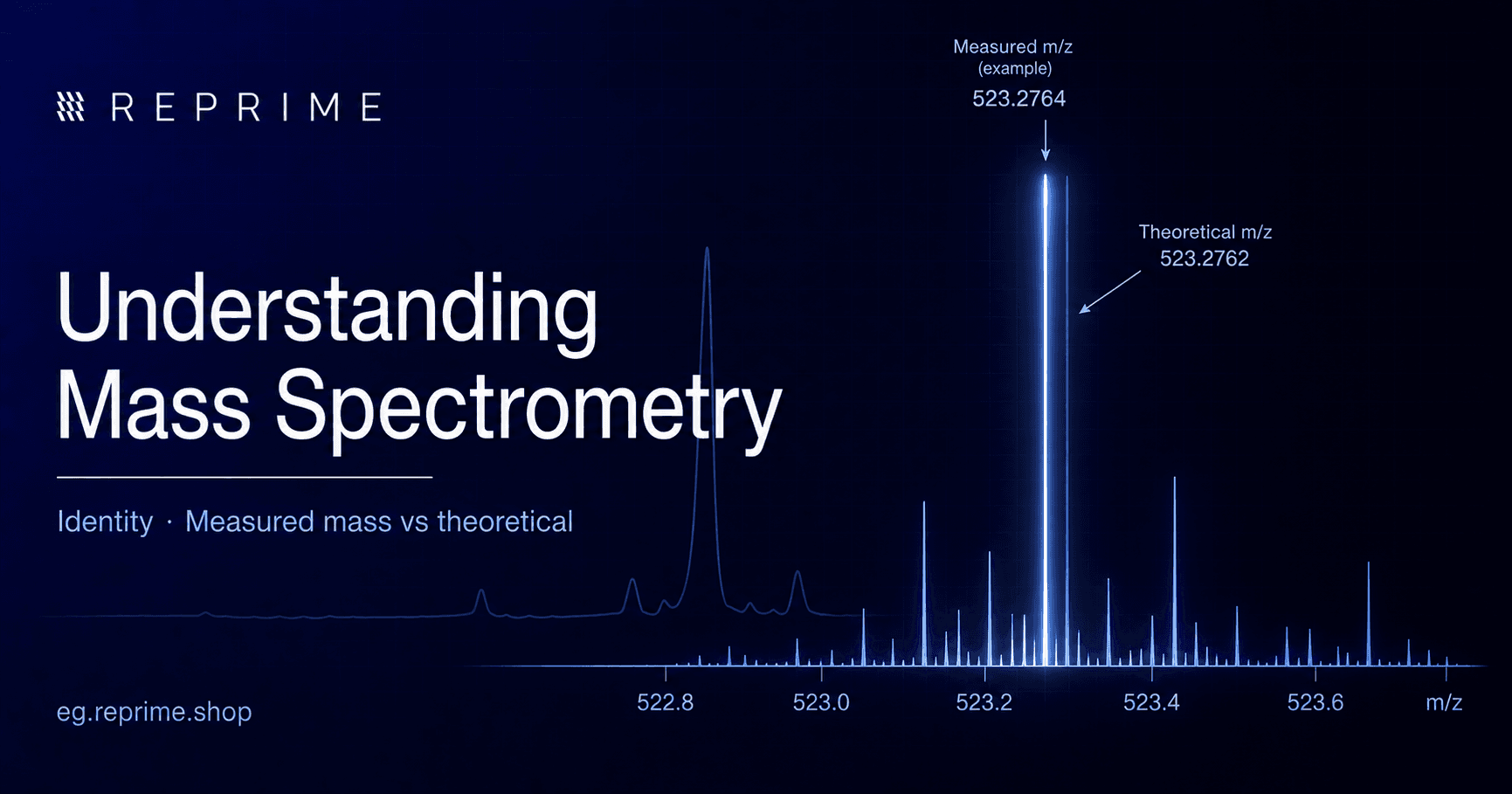
Mass spectrometry is the workhorse technique for confirming peptide identity. Here is what it measures, how REPRIME uses it, and how it pairs with HPLC.
Mass spectrometry (MS) is the workhorse technique for confirming peptide identity. Where HPLC tells you how pure a sample is, MS tells you whether the peptide in the sample is actually the molecule it is supposed to be. Together they are the two pillars of every REPRIME Certificate of Analysis.
What MS measures
Mass spectrometry measures the mass-to-charge ratio (m/z) of ionized molecules. For peptide identity confirmation, the workflow is:
- The peptide sample is ionized — typically by electrospray ionization (ESI) for peptides
- The ionized molecules travel through a mass analyzer (time-of-flight, quadrupole, or orbitrap)
- A detector counts the ions arriving at each m/z value
- The instrument outputs a spectrum: x-axis is m/z, y-axis is signal intensity
A peptide has a theoretical molecular weight based on its known amino-acid composition. The MS spectrum should show a peak at — or very close to — that theoretical value.
Why 'very close'
In practice, MS measurements have small but real error margins. The exact tolerance depends on the instrument:
- High-resolution MS (orbitrap, FT-ICR): less than 5 ppm error, often under 1 ppm
- Standard quadrupole MS: roughly 50–100 ppm error
For a peptide with theoretical mass of 4,813.2 Da, that is a measurement window of 5 mDa on a high-resolution instrument — small enough to discriminate between the target peptide and a deamidated variant (which differs by approximately 1 Da).
How REPRIME uses MS
For every batch, REPRIME's contract laboratory runs MS on the lyophilized peptide. The COA shows:
- The experimental MS value
- The theoretical MS value for the target peptide
- The difference (in Da and in ppm)
If the difference exceeds the documented tolerance, the batch is rejected and does not ship.
MS for blended peptides
For products like CJC-1295 + Ipamorelin and BPC-157 + TB-500, MS confirms both peptides are present at their expected molecular weights. The chromatographic separation makes this even more useful — the MS spectrum shows two peaks at two predictable m/z values, with the ratio of signal intensities matching the documented blend ratio.
MS vs HPLC: complementary, not redundant
The two techniques answer different questions:
- HPLC quantifies purity — what fraction of the sample is the target molecule. See Understanding HPLC Testing.
- MS confirms identity — whether the target molecule is what it should be.
A sample can be 99.9% pure (HPLC) of the wrong peptide. A sample can be the right peptide (MS) with significant impurities. Only when both pass does the batch ship.
Reading the MS section of a COA
When you read a REPRIME COA, the MS section will typically show:
- Theoretical monoisotopic mass
- Theoretical average mass
- Observed mass (with error in Da and ppm)
- Pass/fail against the documented tolerance
If the COA you are looking at does not have MS data, that is a red flag. See also Reading a Certificate of Analysis for a line-by-line walkthrough of a complete REPRIME COA.
Browse all batch documents in the Certificates repository.