
Quality
Understanding Peptide Purity
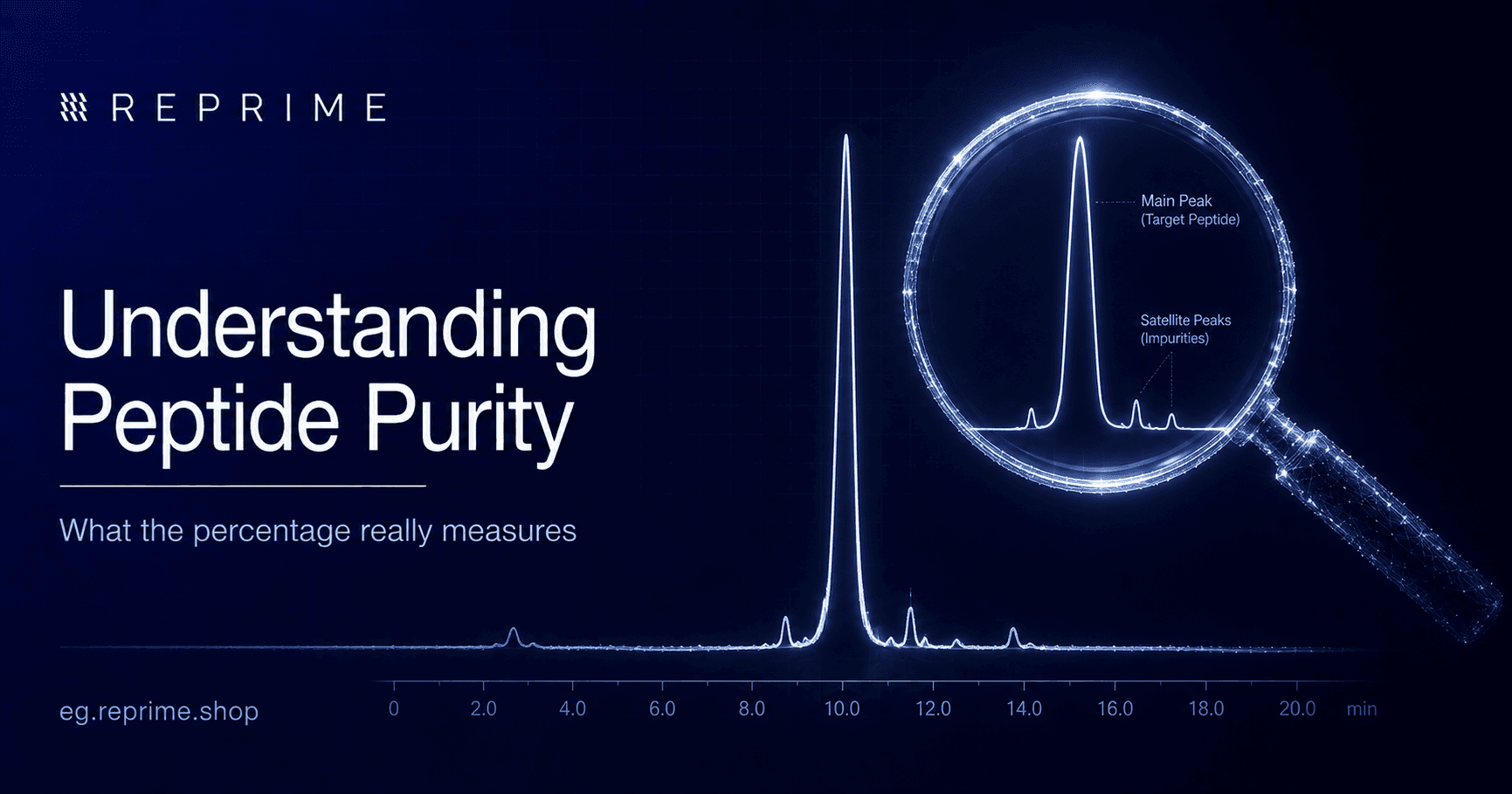
What a peptide purity percentage actually measures, what the impurities are, why purity and identity are different questions, and what the number can't tell you.
"Purity" is the most quoted number in research-peptide catalogs and one of the most misunderstood. This page explains what the percentage actually measures, what the impurities are, and what a purity figure does and does not tell you. For how the number is produced, see Understanding HPLC Testing; this page is about what it means.
What "99% pure" actually means
A peptide purity figure is a chromatographic ratio: the fraction of the detected material that eluted as the target compound on an HPLC run, calculated from peak areas. "99% main-peak purity" means 99% of what the detector saw was the main peak; the remaining 1% is related substances — near-identical by-products and degradation species.
Two things follow. First, the number is method-dependent: it is only as good as the chromatography behind it, which is why the chromatogram itself belongs on the COA rather than a bare percentage. Second, it is a statement about composition at the time of analysis — not a permanent property of the vial.
Identity vs purity
Identity confirms the molecule is what the label says. Purity quantifies what fraction of the material is that molecule. Both numbers belong on every COA, and neither substitutes for the other: a sample can be 99% pure of the wrong peptide, and a correctly identified peptide can be heavily contaminated. At REPRIME, identity is established by mass spectrometry and purity by HPLC — two different questions, two different instruments.
What the impurities actually are
For synthetic peptides, the related substances behind the missing fraction are well understood:
- Deletion peptides — sequences missing one residue, from a coupling step that didn't complete during synthesis. The longer the peptide, the more opportunities.
- Oxidation products — methionine and tryptophan residues are the usual targets.
- Deamidation products — asparagine and glutamine converting to acidic species over time or under stress.
- Racemized variants — residues flipped to the mirror-image form during synthesis.
These matter because they are nearly identical to the target molecule — hard to separate, and invisible without proper analytics.
What purity does not tell you
- Identity — covered above; the headline case.
- Sterility and endotoxin — biological safety of the material is tested separately, with its own limits on the COA.
- Condition today — a purity figure describes the batch at the date of analysis. Storage abuse afterwards degrades real-world purity without changing the paper; that is why storage discipline matters (Peptide Storage Guidelines) and why the COA carries an expiry date.
How purity is reported at REPRIME
Every batch is tested independently, the full chromatogram and related-substances figures are published in the open Certificates repository, and the current batch's main-peak figure appears on each product page. The release threshold is greater than 98% main-peak purity — batches under it do not ship. Comparing figures across batches over time is a legitimate way to judge a supplier: drifting purity is a warning sign.
Frequently asked questions
Is 99% purity good for a research peptide?
Yes — REPRIME's release threshold is greater than 98% main-peak purity, and typical batches run higher. More important than the headline number is that the chromatogram and related substances are published, so the figure can be checked rather than taken on faith.
Does high purity mean the peptide is the right one?
No. Purity and identity are different measurements. A purity figure says how much of the sample is one dominant compound; mass spectrometry confirms that the compound is the labeled peptide. A trustworthy COA reports both.
Can purity change after the COA is issued?
The documented figure describes the batch at the date of analysis. The material itself degrades with time, heat, moisture, and freeze-thaw stress, so real-world purity depends on storage. Follow the storage conditions and expiry on the COA.