
Quality
How Research Peptides Are Made
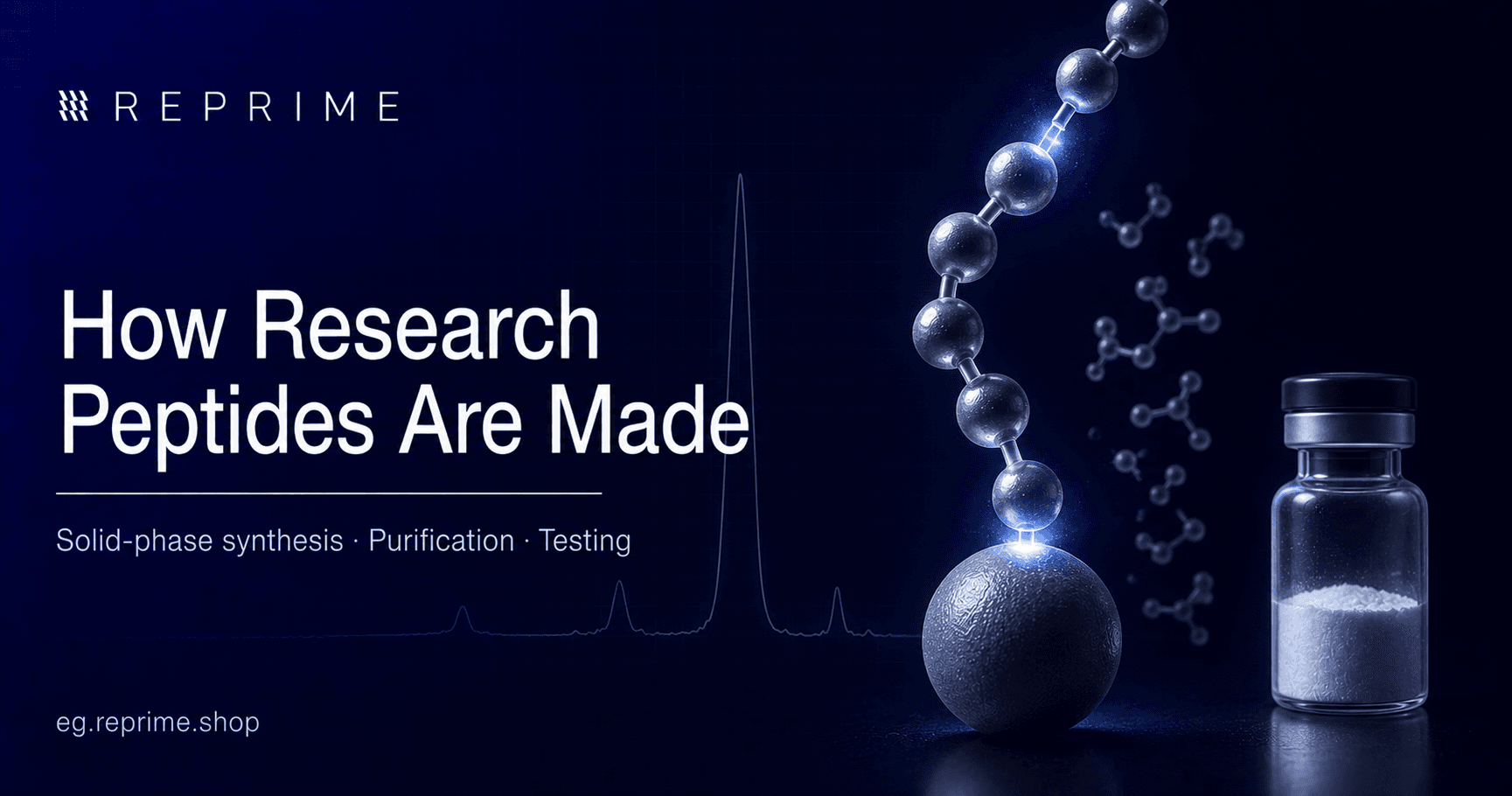
From sequence to vial: how solid-phase peptide synthesis assembles a peptide one residue at a time, why deletion sequences arise, and how purification, testing, and lyophilization finish the job.
Synthetic research peptides are made by chemical synthesis — most commonly solid-phase peptide synthesis (SPPS), in which a peptide chain is assembled one amino acid at a time while anchored to an insoluble support. The finished chain is released, purified, tested, and freeze-dried into the vial a laboratory receives. This article explains that journey conceptually: how SPPS works, why no synthesis is perfect, and how the process connects to the purity, identity, and handling topics covered across this journal. It is a manufacturing explainer, not a protocol — nothing here is an executable synthesis procedure.
The workflow, end to end:
- Sequence design — the target peptide, defined residue by residue
- Chain assembly — solid-phase synthesis, one coupling cycle per residue
- Cleavage and deprotection — releasing the finished chain as crude material
- Purification — separating the target from its process-related relatives
- Analytical characterization — identity and purity, documented per batch
- Lyophilization — drying the purified peptide into stable research material
What is solid-phase peptide synthesis?
SPPS was introduced by R. Bruce Merrifield in 1963 and earned the 1984 Nobel Prize in Chemistry "for his development of methodology for chemical synthesis on a solid matrix" (see References). The idea that made it revolutionary is anchoring: the first amino acid is attached to an insoluble resin — small polymer beads — so the growing chain stays put while everything else can be washed away between steps.
Assembly then proceeds in repeated cycles. Each incoming amino acid arrives with its reactive positions temporarily blocked by protecting groups, so it can form only the intended peptide bond. One cycle conceptually means: unblock the growing chain's end, couple the next protected amino acid to it, wash, repeat. Modern practice overwhelmingly uses the Fmoc protection strategy, which has become the method of choice for research-scale synthesis (Behrendt et al., 2016). Cycle by cycle, the sequence grows — tirzepatide's 39 residues mean 38 coupling steps — until the full chain is assembled on the bead.
Why no synthesis is perfect
Every coupling step is a real chemical reaction with a real efficiency below 100%, and the arithmetic compounds: at even 99% efficiency per step, a 39-residue chain emerges with a meaningful fraction of molecules that missed at least one step along the way. That is the origin of process-related impurities:
- Deletion sequences — a coupling step didn't complete for some molecules, so a residue is missing.
- Truncations — chains that stopped growing early.
- Incomplete deprotection — a protecting group that survived where it shouldn't have.
- Side reactions — chemical modifications such as oxidation of sensitive residues during synthesis or cleavage (the purity article catalogs the recurring species).
The essential idea: a successful synthesis produces the target sequence as the dominant species surrounded by a small population of near-identical relatives. The batch is then judged by how well the next stages remove and quantify that population — never by pretending it doesn't arise.
What are deletion peptides?
A deletion peptide is a related sequence missing one or more intended residues because a synthesis step did not proceed to completion for that molecule. They matter analytically for exactly the reason they are hard: differing from the target by a single residue, they behave almost identically — which is why resolving them chromatographically is the hard case HPLC testing is designed around, and why their quantified share belongs in the related-substances section of a batch's Certificate of Analysis.
Cleavage and deprotection
Once the chain is complete, it is chemically released from the resin, and the remaining protecting groups are removed. What comes off the support is crude peptide: the target sequence together with the deletion, truncation, and side-reaction species accumulated during assembly, plus process residues. Crude material is an intermediate, not a product — it exists to be purified.
Purification
Purification separates the target peptide from its relatives, typically by preparative chromatography — commonly reverse-phase, the same separation principle that analytical HPLC uses at measurement scale. Two distinctions matter here. First, crude versus final purity: the fraction of target in the crude mixture is a synthesis outcome, while the number on the vial describes the purified product. Second, purification versus characterization: purifying selects the material; testing then measures what was actually achieved, on separate instruments, producing evidence rather than assumptions. That separation of stages is why a purity figure is a measured result and not a promise.
How the finished peptide is tested
The purified material is characterized by methods that answer different questions: mass spectrometry establishes identity (the measured mass against the sequence's theoretical mass — the check that catches a wrong or modified chain), analytical HPLC quantifies purity, and the batch's COA documents both alongside sterility and stability data. Downstream of the paperwork, chain-of-custody controls address the remaining question the instruments cannot: whether the vial in your hands corresponds to the batch that was tested.
Why the final material is lyophilized
The purified peptide is formulated and freeze-dried, because water drives the degradation chemistry that would otherwise consume a stored solution — the powder-versus-solution explainer covers the reasoning, and the storage guidelines cover what the dry state expects from its keeper. Lyophilization is the last manufacturing step and the reason a research peptide arrives as a cake of powder rather than a vial of liquid.
High purity is not the same as everything being correct
Synthesis makes this concrete. Purity is not identity: a clean chromatogram can describe the wrong sequence. Identity is not authenticity: a correct molecule in an untracked vial proves nothing about what you were shipped. Purity is not biological activity: activity depends on sequence, structure, and handling after the vial is opened. And a successful synthesis is not a validated product — it is the first stage of a chain in which purification, testing, documentation, and custody each add the evidence the previous stage cannot. What research peptides are as a category only makes sense with that whole chain in view.
The full lifecycle
The complete arc of a research peptide, with each stage's deeper article:
- Sequence — the designed target
- Synthesis — SPPS chain assembly (this article)
- Crude material — the unpurified mixture off the resin
- Purification — preparative separation of the target
- Testing — purity, identity, and the batch COA
- Lyophilization — the stable dry form
- Storage — the cold, dark, sealed wait
- Reconstitution — returning to solution for research use
Frequently asked questions
What is solid-phase peptide synthesis?
Solid-phase peptide synthesis (SPPS) is the standard method for making synthetic peptides: the chain is assembled one amino acid at a time while anchored to an insoluble resin, with washing between steps, then released, purified, and tested. It was introduced by R. Bruce Merrifield in 1963 and recognized with the 1984 Nobel Prize in Chemistry.
Why can synthetic peptides contain deletion sequences?
Because each coupling step has an efficiency below 100%, some molecules miss a step, producing chains lacking one or more intended residues. The longer the peptide, the more opportunities. Purification removes most of these near-identical relatives, and HPLC quantifies what remains.
Why are peptides purified after synthesis?
Because synthesis yields crude material — the target sequence mixed with deletion, truncation, and side-reaction species. Preparative chromatography separates the target from those relatives; analytical testing then measures the result. Purification selects the material, characterization proves it.
Why are research peptides often lyophilized?
Because water drives peptide degradation chemistry. Freeze-drying the purified peptide into a stable powder extends practical shelf life from weeks to years, which is why research peptides ship dry and are only returned to solution close to the time of use.
References
- Merrifield — Solid Phase Peptide Synthesis. I. The Synthesis of a Tetrapeptide — Journal of the American Chemical Society (1963)
- The Nobel Prize in Chemistry 1984 — R. Bruce Merrifield — NobelPrize.org
- Behrendt, White & Offer — Advances in Fmoc solid-phase peptide synthesis — Journal of Peptide Science (2016)