
Quality
Lyophilized Powder vs Solution
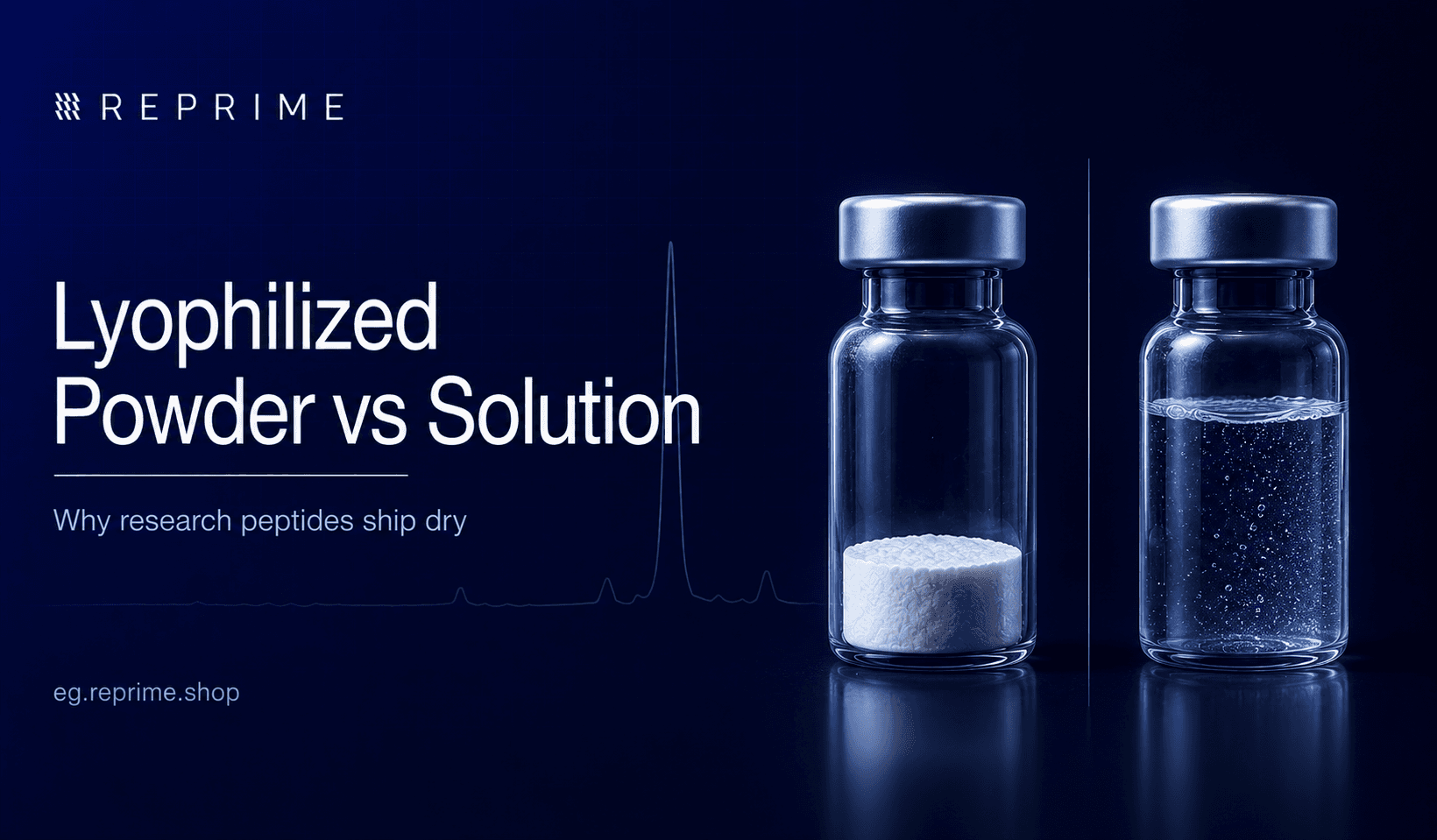
Why every research-grade peptide ships as freeze-dried powder rather than pre-reconstituted solution — and how that choice affects stability, shipping, and protocol control.
Almost every research-grade peptide ships as lyophilized (freeze-dried) powder rather than pre-reconstituted solution. This is deliberate and worth understanding — the choice affects stability, shipping, and the kind of control researchers get over their protocols.
What lyophilization is
Lyophilization is a freeze-drying process: the peptide solution is frozen, then the water is sublimated under vacuum, leaving a stable solid behind. The resulting 'cake' or powder contains the peptide plus any bulking agents and excipients added before freezing. Most importantly, the water content is dramatically reduced — typically to less than 1% residual moisture.
Why this matters
Water is the medium for most peptide degradation chemistry. Hydrolysis cleaves peptide bonds; deamidation converts asparagine and glutamine residues to other species; oxidation hits methionine and tryptophan residues. All of these reactions happen far faster in solution than in dry form — they are the same chemistry behind purity loss over time.
By shipping the peptide dry, REPRIME extends the practical shelf life from weeks (in solution) to years (lyophilized at -20°C). That is the entire reason every research peptide in the REPRIME catalog ships as powder.
What the customer reconstitutes with
REPRIME peptides are reconstituted with sterile diluent — typically bacteriostatic water or sterile water depending on the protocol. The choice belongs to the researcher; some experiments require BAC-free water, others tolerate it.
Reconstitution should happen close to the time of use. The COA specifies the documented stability window for the reconstituted solution. For storage discipline, see Peptide Storage Guidelines.
Why not just ship pre-reconstituted?
Three reasons:
- Shelf life. Solution form would last weeks; lyophilized lasts years.
- Shipping temperature. Solution shipped through Cairo summer would degrade noticeably. Lyophilized powder survives. See Shipping Peptides in Hot Climates.
- Researcher control. Reconstitution volume and diluent choice belong to the researcher's protocol, not the manufacturer's. Shipping powder preserves that control.
A note on 'premixed' suppliers
A small number of suppliers ship peptides pre-reconstituted in proprietary diluents, citing 'convenience.' This is generally a sign of cost-cutting rather than quality — the supplier saves on lyophilization equipment but transfers the stability problem to the customer. REPRIME does not sell pre-reconstituted peptide.
How REPRIME labels it
On every product page, you will see Form: Lyophilized Powder in the spec block. The label is explicit because it is a material property, not a marketing claim. Read every product's COA for the storage and reconstitution detail specific to that compound.