
Quality
Understanding HPLC Testing
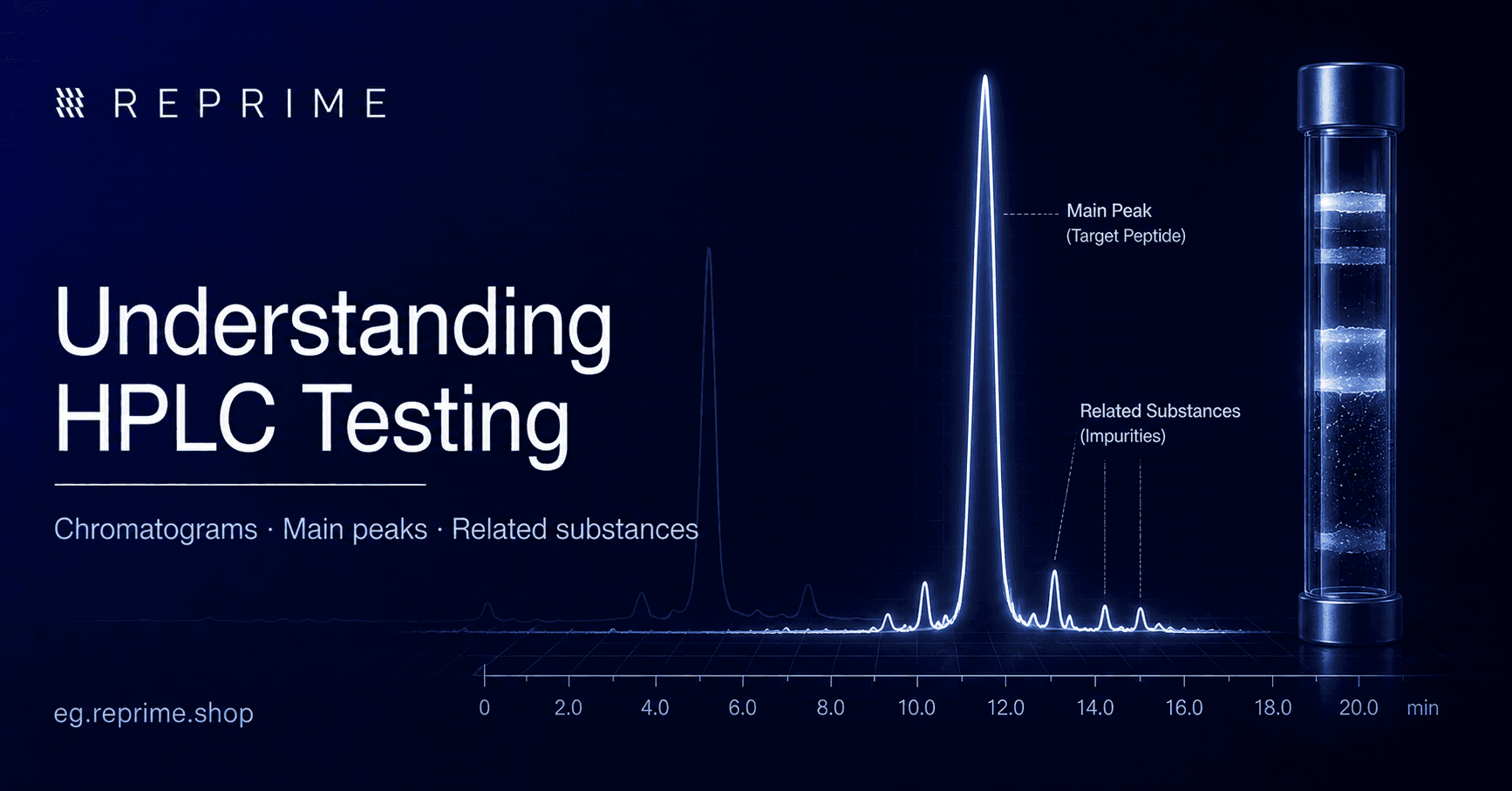
How HPLC works, how to read a chromatogram, what the main peak and purity percentage represent — and what HPLC alone can never prove about a peptide.
High-performance liquid chromatography — HPLC — is the analytical method behind the purity figure on every REPRIME Certificate of Analysis. This page explains how the method works, how to read a chromatogram, and what HPLC can and cannot establish. For what the purity number itself means, see Understanding Peptide Purity; for the identity side of testing, see Understanding Mass Spectrometry.
What HPLC is
HPLC is a separation technique. A small amount of the peptide sample is dissolved and pushed under high pressure through a column packed with fine particles. Different molecules in the sample interact with the column material to different degrees, so they travel through it at different speeds and exit — "elute" — at different times. A detector at the column outlet records signal continuously, producing the chromatogram: a trace of detector signal against time.
For peptides, the standard setup is reversed-phase HPLC, where separation is driven largely by how hydrophobic each molecule is. Two molecules that differ by a single oxidized residue or a missing amino acid usually elute at slightly different times — which is exactly what makes the method useful for purity work.
Reading a chromatogram
Each peak on the trace represents a compound separated by the column. Three things matter when reading one:
- The main peak is the target peptide, usually the tallest peak by far, annotated with its retention time.
- Smaller peaks are related substances — synthesis by-products and degradation species that the column separated from the target.
- The purity percentage is the area-under-curve ratio: the main peak's area divided by the total area of all peaks, expressed as a percent.
A clean chromatogram is not one with a single peak — trace-level related substances are normal — but one where the main peak dominates and the remaining peaks are individually small and documented.
Why the hard cases are hard
The impurities that matter most in peptide synthesis are the ones most similar to the target: deletion peptides missing one residue, and oxidized or deamidated variants. Because they are nearly identical molecules, they elute close to the main peak, and resolving them cleanly is what separates a rigorous method from a cosmetic one. This is why REPRIME's COAs report related substances explicitly rather than quoting a single rounded number.
What HPLC cannot establish
HPLC quantifies how much of the sample is one dominant compound. It does not, by itself, prove that the compound is the peptide on the label — a sample can be 99% pure of the wrong molecule and produce a beautiful chromatogram. Identity is established separately by mass spectrometry, which is why every REPRIME batch carries both tests. HPLC also says nothing about sterility or endotoxin levels; those are separate assays with their own sections on the COA.
Where you see HPLC results
Every batch's chromatogram and main-peak figure are published in the open Certificates repository, and each product page shows the current batch's purity. REPRIME's release threshold is greater than 98% main-peak purity; batches below it do not ship. Reading a Certificate of Analysis walks through the document section by section.
Frequently asked questions
What does HPLC measure?
HPLC separates the components of a sample and measures how much of each is present. For research peptides it produces the purity figure: the main peak's share of the total peak area on the chromatogram.
Can HPLC prove a peptide's identity?
No. HPLC shows how pure the dominant compound is, not what it is. Identity is confirmed by mass spectrometry, which checks the molecule's mass against the theoretical value for the labeled peptide. A rigorous COA includes both.
What is a "main peak"?
The main peak is the chromatogram peak corresponding to the target peptide. The purity percentage is its area divided by the total area of all detected peaks — so "99% main-peak purity" means 99% of the detected material eluted as the target compound.