
Quality
Shipping Peptides in Hot Climates
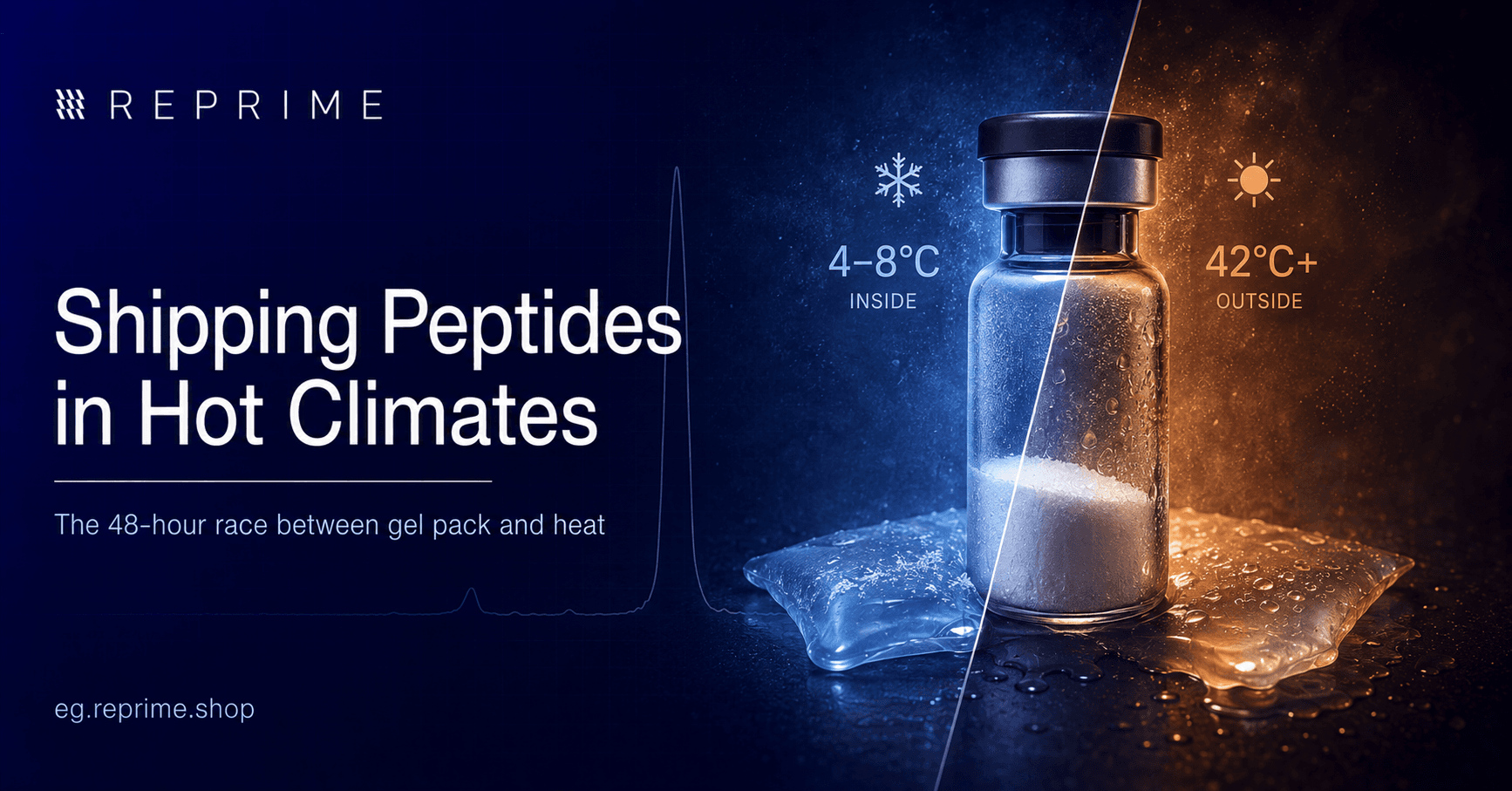
Lyophilized peptide in transit is in a 48-hour race against the gel pack. The principles that make it work in Egypt apply anywhere temperature is a concern.
Shipping research peptides through hot climates is harder than shipping most reagents. The vial spends 24–48 hours in courier hands, possibly in direct sun, possibly with periods at 40°C or above. REPRIME's packaging is designed to handle Egypt, but the principles apply anywhere temperature is a concern.
The temperature window
For lyophilized peptide in transit, the practical ceiling is 48 hours at ≤25°C for most peptides. Above 25°C accelerates degradation; above 30°C accelerates it noticeably; above 40°C makes a 48-hour delivery marginal.
The phase-change gel pack inside REPRIME's insulated envelope is conditioned to refrigerator temperature (approximately 4–8°C) before shipping. As external heat enters the envelope, the gel absorbs it by melting — buying time before the internal temperature rises. The 48-hour window is the duration during which the gel holds internal temperature in the 4–10°C range.
What can go wrong
In our experience, the most common cold-chain failures are:
- Courier delays at customs or border crossings — a 48-hour delivery becomes 96 hours
- Packages sitting in the sun at a delivery point — internal temperature climbs faster than the gel can absorb
- Wrong recipient at delivery, package returned to depot — the cycle restarts with a thawed gel pack
When delivery is delayed, the gel pack thaws. After 72 hours the envelope is at ambient temperature.
Why lyophilized powder forgives some of this
The reason every research peptide ships as lyophilized powder, not pre-reconstituted solution, is exactly this transit problem. Lyophilized peptide survives a 72-hour ambient excursion far better than reconstituted solution would. The peptide is not immune — it still degrades faster at 30°C than at -20°C — but the failure mode is gradual rather than catastrophic.
For more on the powder-vs-solution choice, see Lyophilized Powder vs Solution.
What we do if a shipment fails
If a REPRIME package arrives outside the 48-hour cold-chain window, or if the gel pack is fully thawed and warm at arrival, contact us. We track every shipment by courier reference; in cases where the temperature window was breached, we ship a replacement at no charge.
This is not a hypothetical — it has happened. We would rather replace a vial than ship one that may have lost integrity.
What you can do at your end
- Be available for delivery. Couriers leaving a package outside is the worst-case scenario.
- Transfer to freezer immediately. Once the package arrives, the timer starts again. Get the vial to -20°C within a few hours. See Peptide Storage Guidelines.
- Inspect the gel pack. If it is still cold and partially solid, the envelope held its temperature. If it is fully liquid and at room temperature, the cold chain broke.
- Use the verification code. Scan at /verify on first use — confirms the package was not tampered with in transit. See Chain of Custody and Product Authentication.
A note on international shipping
REPRIME currently ships within Egypt only. International cold-chain shipping is an order of magnitude more complex — customs delays alone can push 48-hour transit into 7-day transit, well beyond what passive cold packs can handle. When and if we expand internationally, we will add active-temperature shipping to the catalog. Until then, Egypt-only.
For Egypt-specific shipping detail, see Cold-Chain Shipping in Egypt.