
Education
What Is Selank?
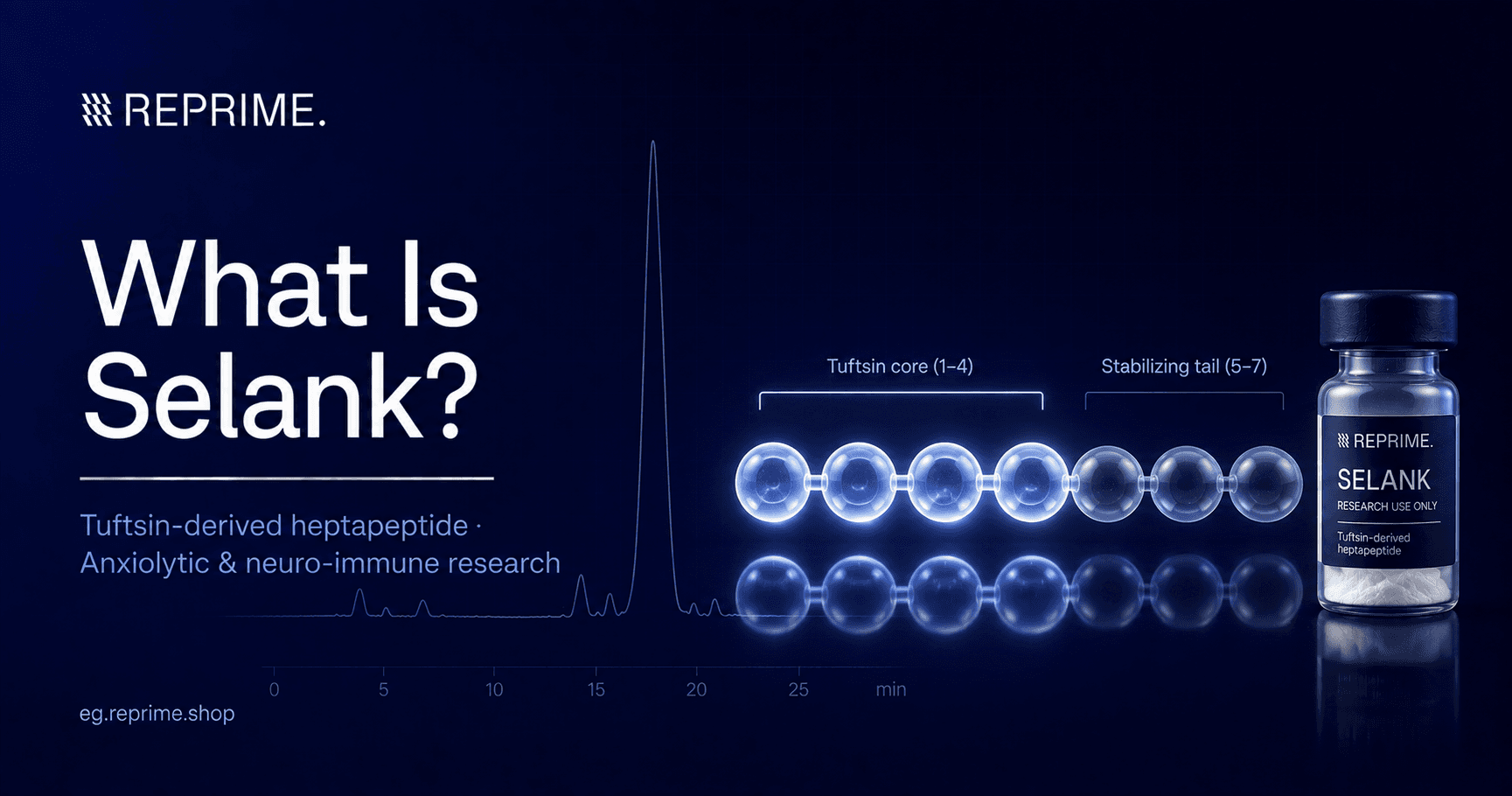
The tuftsin-derived heptapeptide studied in anxiolytic and neuro-immune research — origins, design, and research context.
Selank is a synthetic heptapeptide from the Russian peptide-research tradition: the natural immunomodulatory tetrapeptide tuftsin, extended with a Pro-Gly-Pro tail that protects it from enzymatic breakdown. The design gives a fragile natural sequence a practical laboratory life.
What is Selank?
Tuftsin is a four-residue fragment of immunoglobulin G with a long immunology literature of its own. Selank grafts three stabilising residues onto it, producing a seven-residue peptide stable enough for real protocols. It was developed alongside its sibling Semax — the two share the same stabilisation strategy applied to different parent fragments, compared point by point in Selank vs Semax.
What researchers study it for
Selank's literature spans an unusual intersection: anxiolytic and stress-response models on one side, neuro-immune signalling on the other — a reflection of its tuftsin ancestry. For researchers, that duality is the draw: one compact, stable research peptide relevant to both behavioural and immune endpoints.
Working with research-grade Selank
REPRIME supplies Selank as a lyophilized 15 mg vial, HPLC-verified per batch with a public COA and first-scan verification code. Current batch details are on the Selank product page. Research use only.
Frequently asked questions
What is Selank made from?
Selank is tuftsin — a natural immunomodulatory tetrapeptide from immunoglobulin G — extended with a Pro-Gly-Pro tail for enzymatic stability, giving a seven-residue synthetic peptide.
How does Selank relate to Semax?
They are sibling designs from the same research school: the same stabilising Pro-Gly-Pro strategy applied to different parent fragments — tuftsin for Selank, an ACTH fragment for Semax.
How is research-grade Selank supplied?
As a lyophilized 15 mg vial with batch HPLC verification, a public COA, and a verification code — see the product page.