
Science
Selank vs Semax
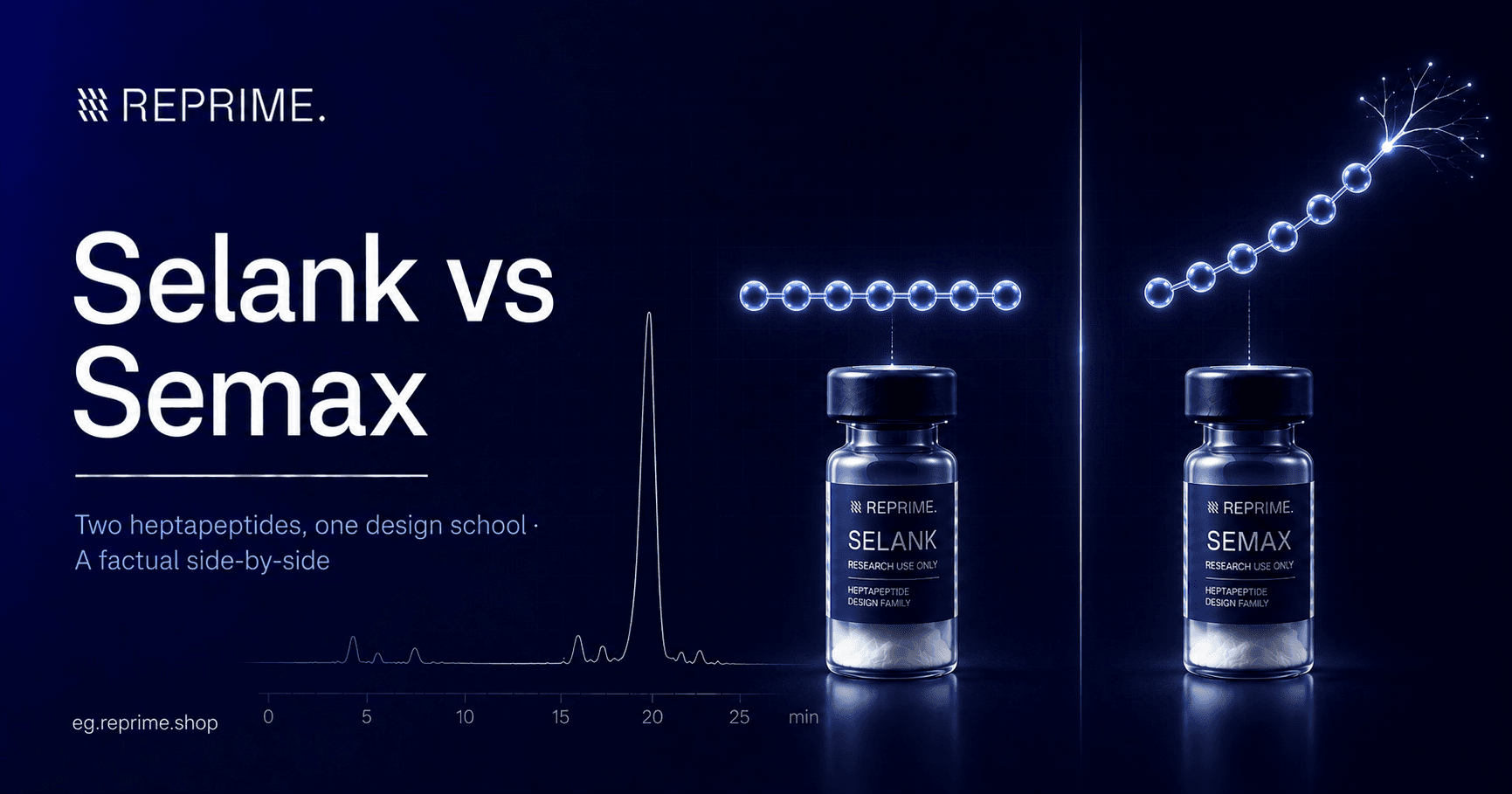
Two sibling heptapeptides from the same design school — how Selank and Semax differ in origin, research focus, and use as laboratory probes.
Selank and Semax are the sibling molecules of Russian peptide research: two seven-residue synthetic peptides built with the same stabilisation trick applied to two different natural fragments. They are compared constantly — and usually vaguely. This page does it precisely.
The short answer
Both peptides take a fragile natural fragment and extend it with a Pro-Gly-Pro tail so it survives enzymatic degradation. The difference is the parent: Selank is built on tuftsin, an immune-derived tetrapeptide, and its literature leans anxiolytic and neuro-immune; Semax is built on the ACTH(4–7) hormone fragment, and its literature leans cognition, neuroprotection, and BDNF-pathway research.
Side-by-side comparison
| Dimension | Selank | Semax |
|---|---|---|
| Parent fragment | Tuftsin (from immunoglobulin G) | ACTH(4–7) (from adrenocorticotropic hormone) |
| Design | Parent + Pro-Gly-Pro stabilising tail | Parent + Pro-Gly-Pro stabilising tail |
| Length | 7 residues | 7 residues |
| Research focus | Anxiolytic, stress-response, neuro-immune signalling | Cognition, neuroprotection, BDNF-pathway work |
| Endocrine activity | None attributed | None — the fragment carries no corticotropic activity |
| Origin | Russian peptide-research school | Russian peptide-research school |
| At REPRIME | Selank 15 mg, lyophilized | Semax 15 mg, lyophilized |
What they share
The design philosophy is identical, and it is the interesting part: both parents are short fragments with real biological signal but hopeless stability, and in both cases three added residues turned them into practical laboratory tools. They are the clearest demonstration in the catalogue that stabilisation chemistry — not just sequence discovery — is what makes a research peptide usable.
Where they differ
Ancestry decides the research programme. Selank inherits tuftsin's immunological context, which is why its literature keeps one foot in neuro-immune territory even when the endpoints are behavioural. Semax inherits a hormone fragment stripped of its hormonal job: ACTH(4–7) carries the neuroactive character of its parent without corticotropic activity, pointing its literature squarely at the CNS. Protocols choose by question — immune-adjacent stress models reach for Selank, cognition and neuroprotection models for Semax — and a substantial slice of the literature simply runs both.
Frequently asked questions
Are Selank and Semax the same thing?
No. They share a design strategy (a natural fragment plus a Pro-Gly-Pro stabilising tail) but have different parent sequences — tuftsin for Selank, ACTH(4–7) for Semax — and correspondingly different research profiles.
Can Selank and Semax be studied together?
They frequently are: the shared design and differing ancestry make them a natural comparative pair in behavioural and neuro-immune research designs.
How are research-grade Selank and Semax supplied?
Both ship from REPRIME as lyophilized 15 mg vials, HPLC-verified per batch with public COAs and first-scan verification codes — see the Selank and Semax product pages.