
Science
IGF-1 LR3: The Long-Acting Variant
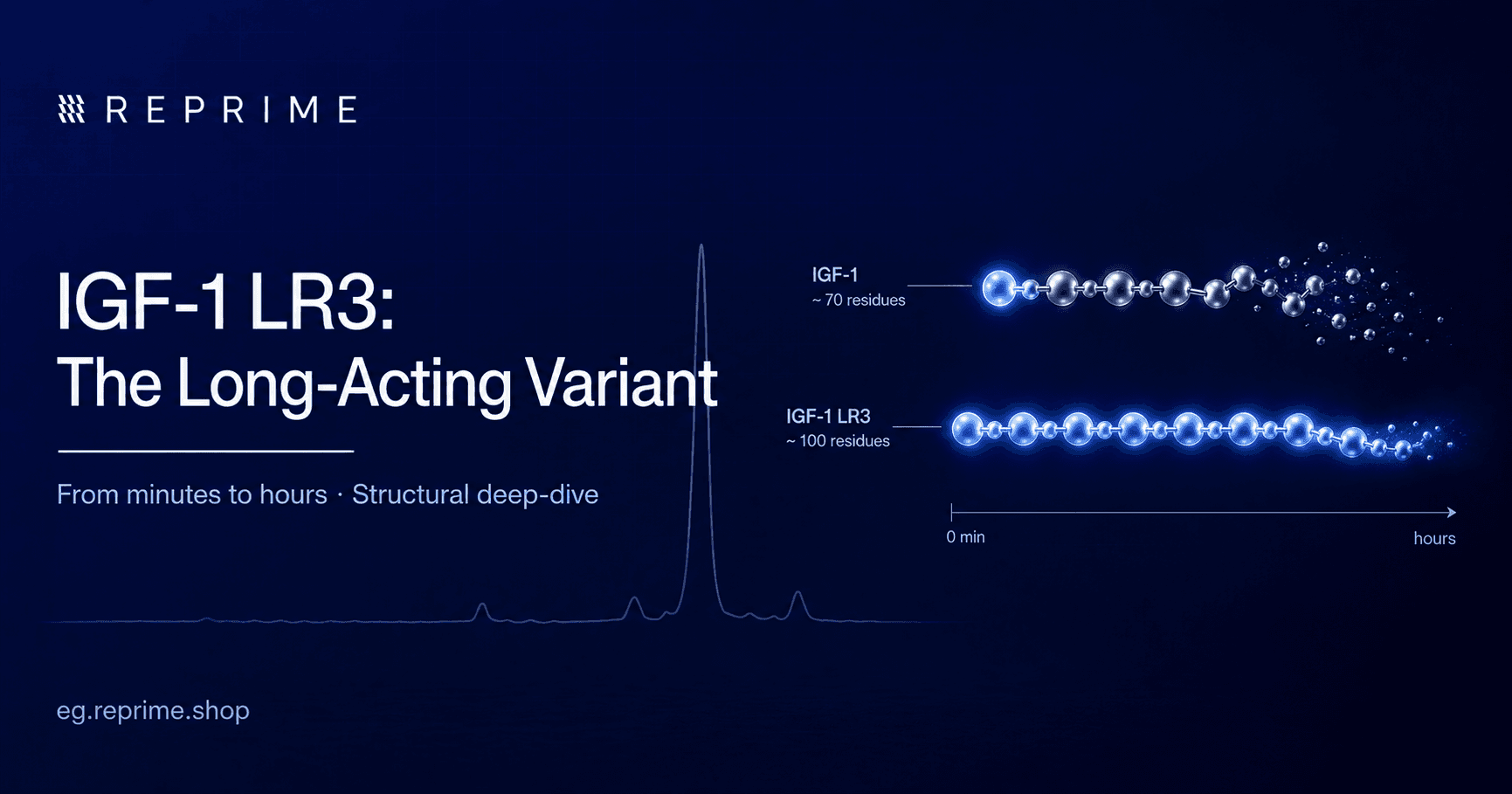
Native IGF-1 has a half-life measured in minutes. IGF-1 LR3 is engineered to last hours — what changed structurally, and why that distinction matters in a research protocol.
Native IGF-1 has a circulating half-life measured in minutes. For research protocols measured in real biological time — hours of sustained signaling rather than transient pulses — that's a problem. IGF-1 LR3 is a synthetic variant designed to last considerably longer, which makes it the more practical research tool for studies that need stable concentrations across a meaningful window. (For the basics first, see the entry-level IGF-1 LR3 explainer.)
What changed
IGF-1 LR3 differs from native IGF-1 in two specific ways:
- R3 substitution — arginine substitutes glutamic acid at position 3, which weakens binding to IGF binding proteins (IGFBPs). Less binding means more free peptide available to engage receptors.
- Extended N-terminus — 13 additional amino acids appended at the N-terminus. This extension resists proteolytic clearance.
Together, these modifications reduce IGFBP sequestration and slow proteolysis. The effective half-life extends from minutes to hours.
Why researchers prefer it
For cell-signaling studies measured in real biological time, native IGF-1's short half-life means the actual effective concentration drops rapidly after introduction. By the time downstream phosphorylation cascades have stabilized, the input signal is already decaying. LR3's longer half-life allows researchers to study sustained signaling without artifacts from kinetic drop-off.
The 100 mcg / 1 mg vials
REPRIME offers IGF-1 LR3 in both 100 mcg and 1 mg sizes. The smaller vial is convenient for pilot work or single-protocol use; the 1 mg vial gives extended-protocol capacity. Both ship lyophilized.
Quality
LR3 is sometimes confused on the market with native IGF-1 because the names are similar and the difference is invisible without analytical chemistry. REPRIME's COA explicitly confirms the LR3 variant via mass spectrometry — the molecular weight is meaningfully higher than native IGF-1, so the assay distinguishes them cleanly. The HPLC report further verifies main-peak purity against the truncated and oxidized variants that can co-elute on standard reverse-phase columns.
Shop IGF-1 LR3.