
Education
What Is Prostamax?
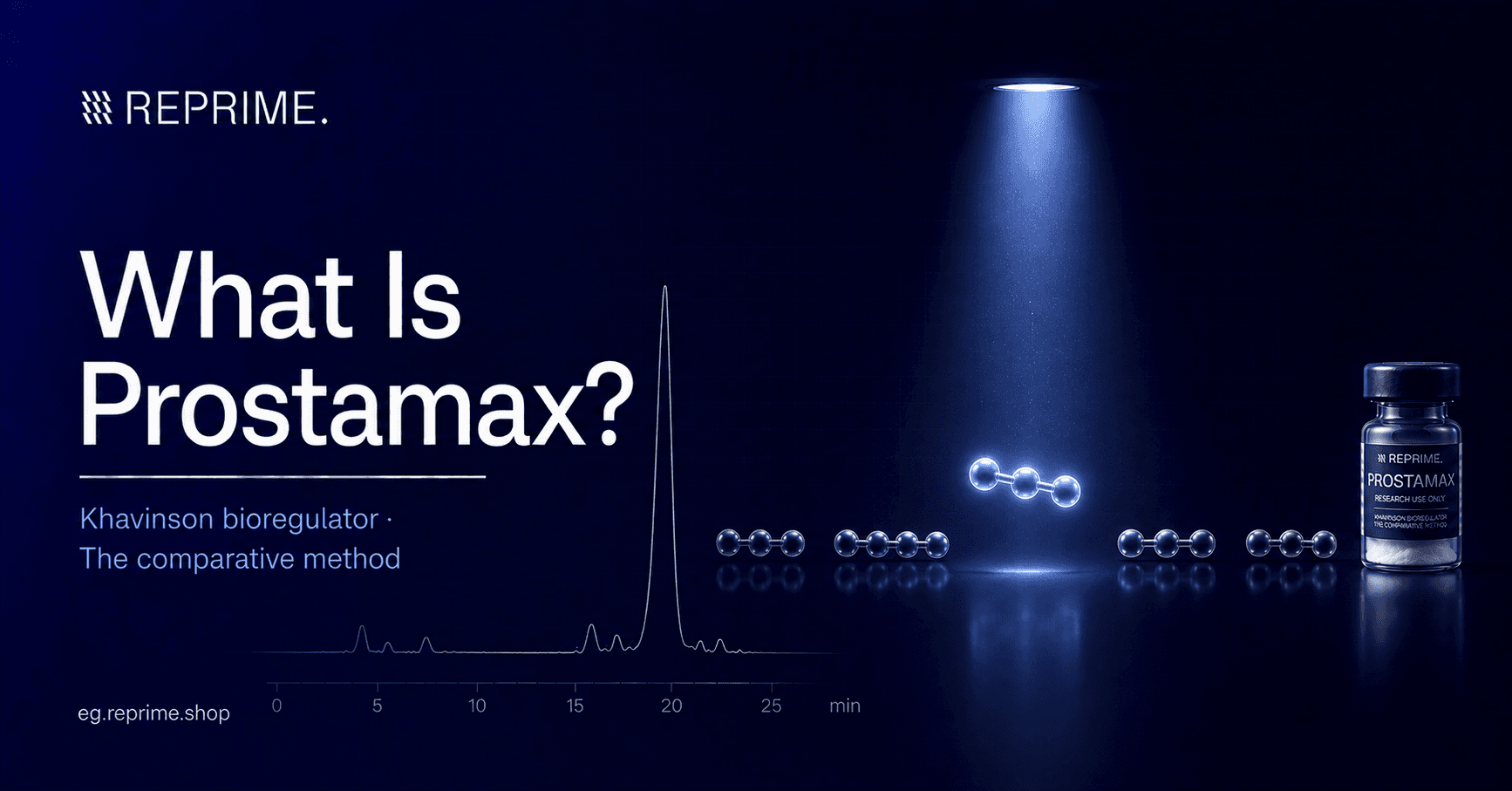
The prostate-research member of the Khavinson bioregulator family — what Prostamax is and its role in the comparative set.
Prostamax is a short synthetic peptide from the Khavinson bioregulator family, studied in prostate-tissue research models. It fills one niche in a family whose entire scientific interest is tissue specificity.
What is Prostamax?
The bioregulator tradition works with ultra-short peptides — typically two to four residues — each examined for signalling associated with a particular tissue. Prostamax is the prostate-context member. As with its relatives, the honest framing is that this is a distinctive, largely single-school literature: interesting, comparative by design, and best approached with verified material and open questions — context the family guide lays out in full.
What researchers study it for
Prostamax appears in prostate-tissue and cell-culture models within the bioregulator literature. Because the family is studied as a set, researchers typically run it alongside members like Cartalax and Testagen under matched conditions — which is why uniform, batch-documented quality across the family matters more here than any single vial's numbers.
Working with research-grade Prostamax
REPRIME supplies Prostamax as a lyophilized 20 mg vial, HPLC-verified per batch with a public COA and first-scan verification code. See the Prostamax product page. Research use only.
Frequently asked questions
What is Prostamax?
A short synthetic peptide from the Khavinson bioregulator family, studied in prostate-tissue research models.
Why are bioregulator peptides studied as a family?
Because the tradition's central claim is tissue-specific signalling — testing that claim inherently means comparing members across tissue contexts under matched conditions.
How is research-grade Prostamax supplied?
As a lyophilized 20 mg vial with batch HPLC verification, a public COA, and a verification code — see the product page.