
Education
The Khavinson Peptide Bioregulators
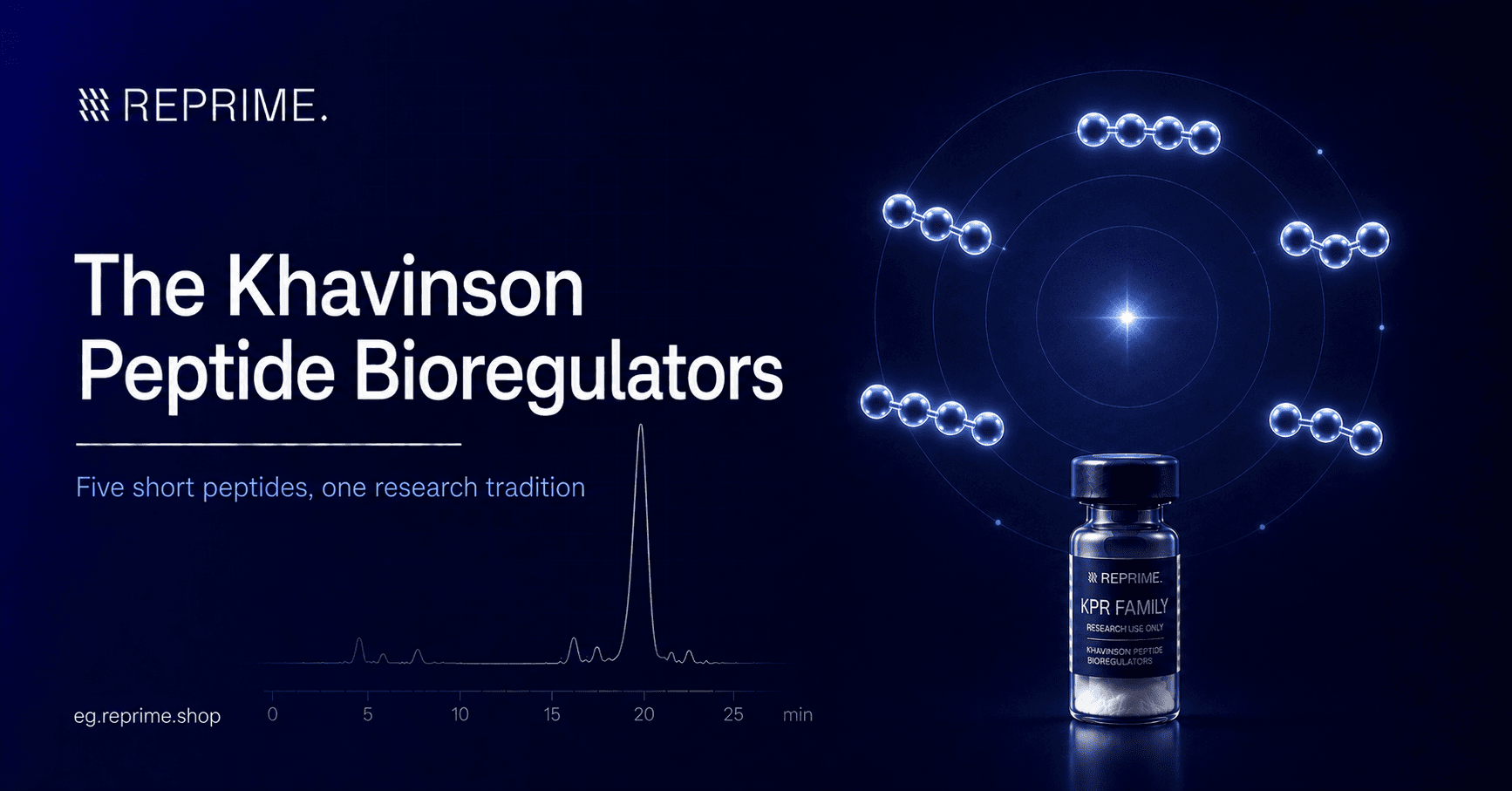
What peptide bioregulators are, where the Khavinson research tradition came from, and how its five catalogue members are studied as a comparative set.
Peptide bioregulators are one of the most distinctive — and most debated — traditions in peptide research: ultra-short peptides, typically two to four residues, studied for tissue-specific signalling. The line runs from Soviet-era work led by Vladimir Khavinson's research school in St Petersburg to the defined synthetic peptides used in laboratories today. This guide explains the idea, the history, and the five family members in the REPRIME catalogue.
What are peptide bioregulators?
The tradition began in the 1970s–80s with tissue extracts — preparations from pineal, thymus, and other organs studied for regulatory effects on their tissue of origin. The pivotal move came later: reducing those extracts to defined ultra-short peptides, so protocols could ask what an exact molecule does rather than what a mixture does. Epithalon, the four-residue successor to the pineal extract epithalamin, is the emblem of that transition.
The organising idea
The family's central claim is tissue specificity: that very short peptides can carry signals selective for particular tissue contexts. That claim is what makes the research inherently comparative — testing it means running family members side by side, under matched conditions, across their assigned contexts. It is also why the literature should be read honestly: it is distinctive, largely from a single research school, and best treated as a standing research question rather than settled science.
The catalogue's five members
| Peptide | Assigned research context | Length |
|---|---|---|
| Epithalon | Pineal function, telomerase activity | 4 residues (AEDG) |
| Pinealon | CNS, neuroprotection | 3 residues (EDR) |
| Cartalax | Cartilage, connective tissue | Ultra-short |
| Prostamax | Prostate tissue | Ultra-short |
| Testagen | Testicular tissue, endocrine models | Ultra-short |
Each is available research-grade — Epithalon, Pinealon, Cartalax, Prostamax, and Testagen — as lyophilized vials with batch documentation.
Why material quality is the whole game here
Comparative research has one non-negotiable: the only variable should be the one under study. When five ultra-short peptides are run across tissue contexts, every vial must be held to the same verified standard — identity confirmed, purity documented, batch recorded — or the comparison quietly breaks. The family's tiny sequences make that standard easy to meet rigorously: synthesis is clean and verification unambiguous, as the synthesis explainer covers in detail.
Frequently asked questions
What is a peptide bioregulator?
An ultra-short peptide — typically two to four residues — studied within the Khavinson research tradition for tissue-specific signalling roles.
Is the bioregulator literature scientifically settled?
No. It is a distinctive body of work originating largely from one research school, and it is best approached as an open, testable research question — which is precisely how comparative protocols treat it.
Which bioregulators does REPRIME supply?
Five: Epithalon, Pinealon, Cartalax, Prostamax, and Testagen — each as a lyophilized, HPLC-verified vial with a public batch COA and verification code.