
Education
What Is Pinealon?
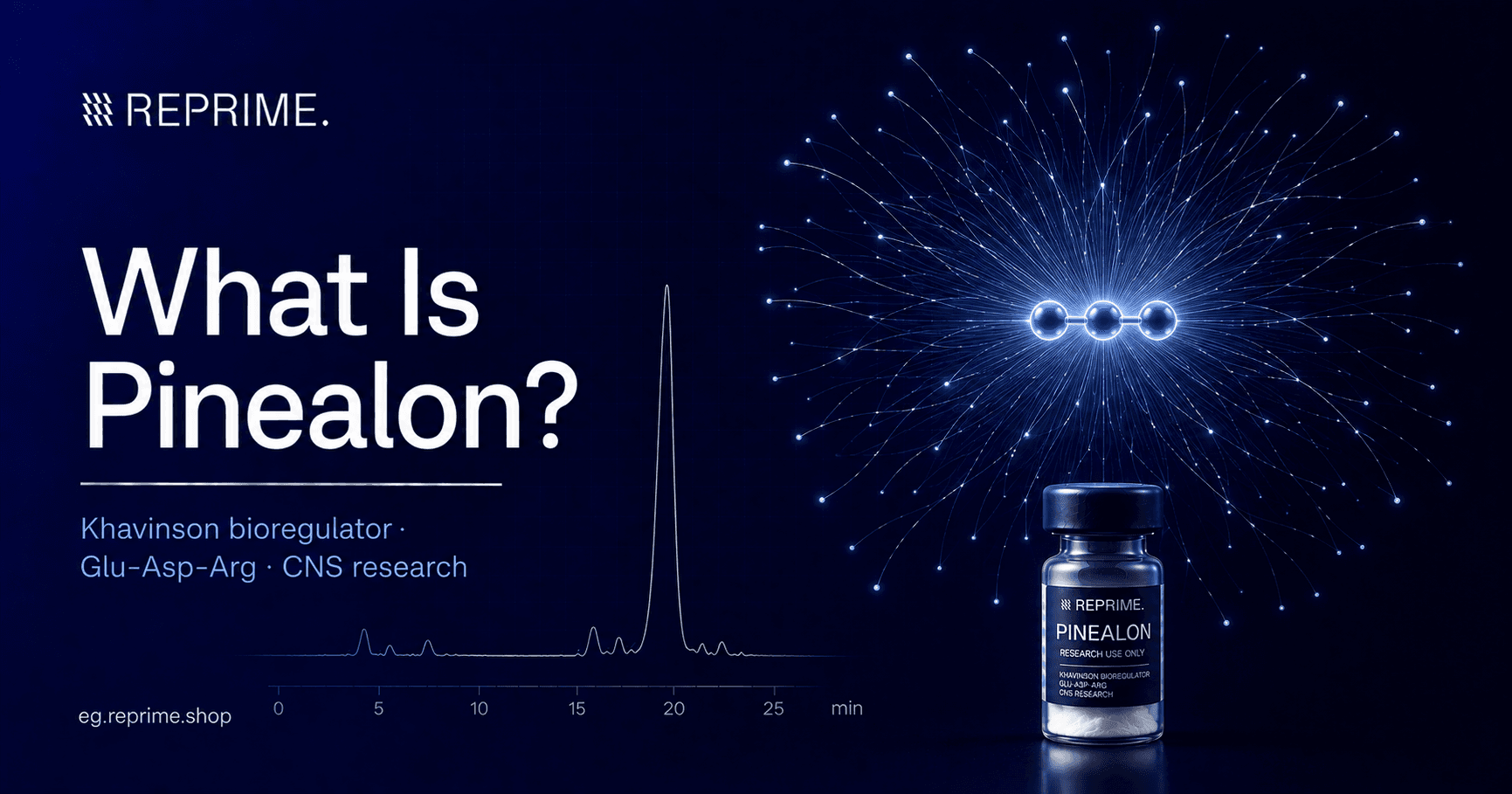
The CNS tripeptide of the Khavinson bioregulator family — Glu-Asp-Arg, its neuroprotection literature, and how it fits the set.
Pinealon is the tripeptide Glu-Asp-Arg (EDR), the central-nervous-system member of the Khavinson bioregulator family. Three residues make it one of the smallest molecules in the catalogue — and one of the simplest to verify beyond doubt.
What is Pinealon?
Within the bioregulator tradition, Pinealon is the brain-context peptide, studied in neuroprotection, cognitive-aging, and oxidative-stress models. It is a separate molecule from Epithalon — the family's pineal-and-telomerase member — though the two are frequently discussed together as the tradition's most-studied pair; the family guide covers how the set fits together.
What researchers study it for
Pinealon appears in CNS-focused laboratory models: neuronal oxidative stress, cognitive aging, and related signalling work. As with the whole family, protocols tend to study it comparatively alongside members like Cartalax, which makes uniform material quality across the set the real experimental requirement. At three residues, Pinealon's synthesis and verification are about as clean as peptide chemistry gets.
Working with research-grade Pinealon
REPRIME supplies Pinealon as a lyophilized 20 mg vial, HPLC-verified per batch with a public COA and first-scan verification code. See the Pinealon product page. Research use only.
Frequently asked questions
What is Pinealon?
The tripeptide Glu-Asp-Arg (EDR) from the Khavinson bioregulator family, studied in CNS, neuroprotection, and cognitive-aging research.
Is Pinealon the same as Epithalon?
No — they are different molecules from the same family: Pinealon is the three-residue CNS-context peptide, Epithalon the four-residue pineal/telomerase-context peptide.
How is research-grade Pinealon supplied?
As a lyophilized 20 mg vial with batch HPLC verification, a public COA, and a verification code — see the product page.