
Education
What Is Cartalax?
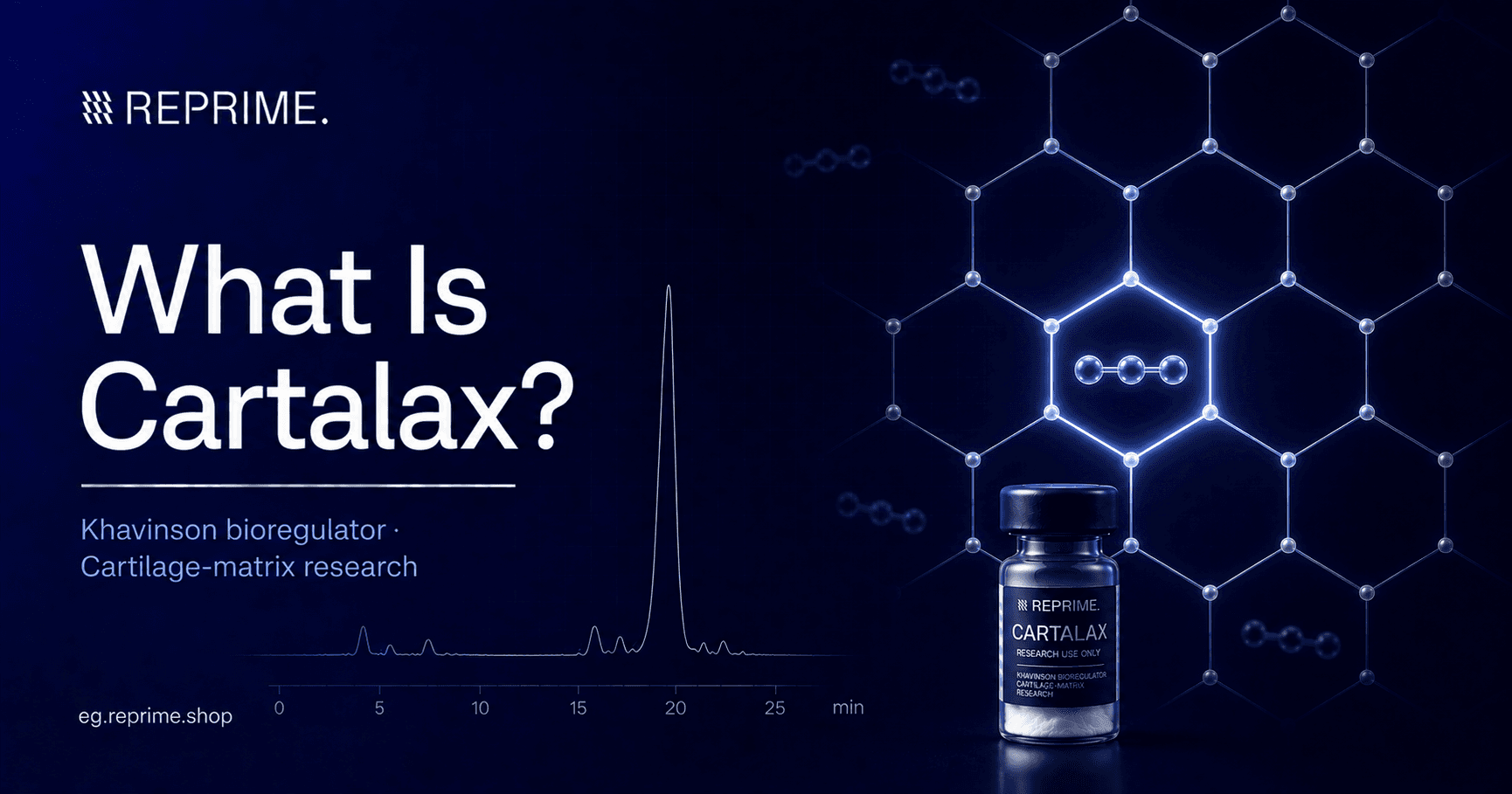
The cartilage-research member of the Khavinson bioregulator family — what Cartalax is and how the family is studied as a set.
Cartalax is a short synthetic peptide from the Khavinson bioregulator family — the research tradition built on ultra-short peptides studied for tissue-specific signalling. Cartalax is the family's cartilage and connective-tissue member.
What is Cartalax?
The bioregulator peptides are typically two to four residues long, each associated in that literature with a tissue context. Cartalax's context is cartilage: chondrocyte and extracellular-matrix models are where it appears. Like its relatives, its scientific interest lies less in any single result than in the family's organising idea — that ultra-short peptides can carry tissue-selective signals, explored in the Khavinson bioregulators guide.
What researchers study it for
Bioregulator research is comparative by design: the family is studied as a set, with each member covering a tissue niche — Pinealon for the CNS, Prostamax for prostate tissue, Cartalax for cartilage. Protocols surveying the family need each member held to the same quality standard, or the comparison itself breaks. The very short sequences make that practical: synthesis is clean, verification unambiguous, and reconstitution forgiving.
Working with research-grade Cartalax
REPRIME supplies Cartalax as a lyophilized 20 mg vial, HPLC-verified per batch with a public COA and first-scan verification code. See the Cartalax product page. Research use only.
Frequently asked questions
What is Cartalax?
A short synthetic peptide from the Khavinson bioregulator family, studied in cartilage and connective-tissue research models.
How is Cartalax used alongside the other bioregulators?
The family is studied comparatively — each member covers a tissue context, so protocols often run several members side by side under identical conditions.
How is research-grade Cartalax supplied?
As a lyophilized 20 mg vial with batch HPLC verification, a public COA, and a verification code — see the product page.