
Education
What Is PT-141?
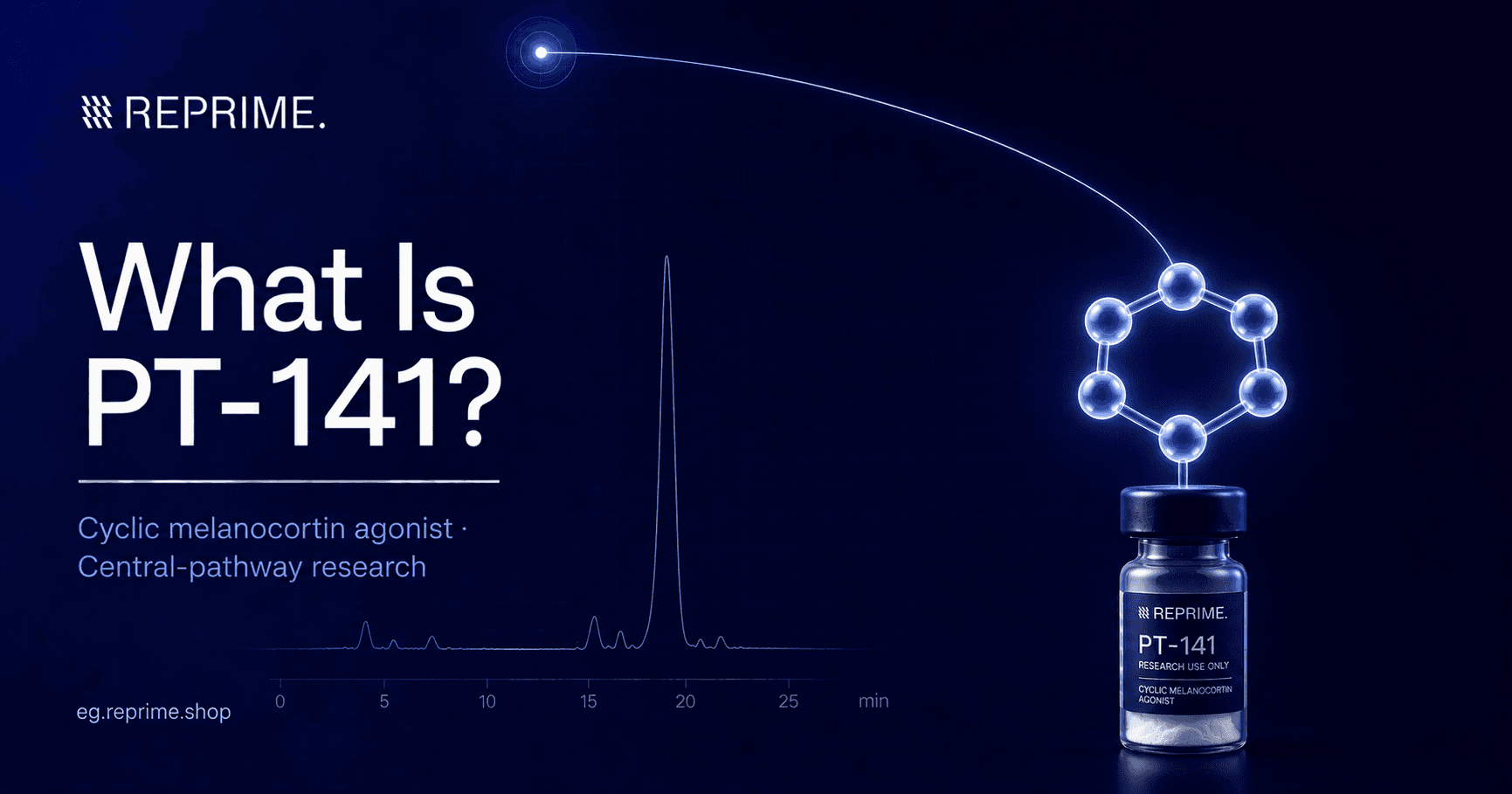
PT-141 (bremelanotide) — the cyclic melanocortin agonist derived from Melanotan II, and its place in central-pathway research.
PT-141, known in the clinical literature as bremelanotide, is a cyclic peptide agonist of the melanocortin receptors. It began life as a derivative of Melanotan II — and became the branch of that family studied for central, rather than pigmentary, melanocortin signalling.
What is PT-141?
Structurally, PT-141 is a close relative of Melanotan II: the same cyclic architecture that gives the family its stability, with a modification that shifts the profile. Where MT-II's research story is dominated by melanogenesis, PT-141's centres on the MC3/MC4 receptor axis — the central melanocortin pathways that sit at the crossroads of appetite, arousal, and energy-balance signalling.
What researchers study it for
The central melanocortin system is one of neuroscience's busiest intersections, and PT-141 is among its best-characterised peptide probes, with a development history that ran through formal clinical study. For receptor-pharmacology work, the MT-II/PT-141 pair offers something valuable: two closely related cyclic agonists whose differences map onto different receptor emphases — laid out side by side in PT-141 vs Melanotan II.
Working with research-grade PT-141
REPRIME supplies PT-141 as a lyophilized 10 mg vial, HPLC-verified per batch with a public COA and first-scan verification code. See the PT-141 product page for current batch documentation. Research use only.
Frequently asked questions
What is PT-141?
PT-141 (bremelanotide) is a cyclic melanocortin-receptor agonist derived from Melanotan II, studied in central melanocortin-pathway research.
How does PT-141 differ from Melanotan II?
They are structural relatives, but their research stories diverge: MT-II is the reference broad agonist with a melanogenesis-dominated literature, while PT-141 is studied for central MC3/MC4-axis signalling.
How is research-grade PT-141 supplied?
As a lyophilized 10 mg vial with batch HPLC verification, a public COA, and a verification code — see the product page.