
Science
The Cellular-Energy Research Toolkit
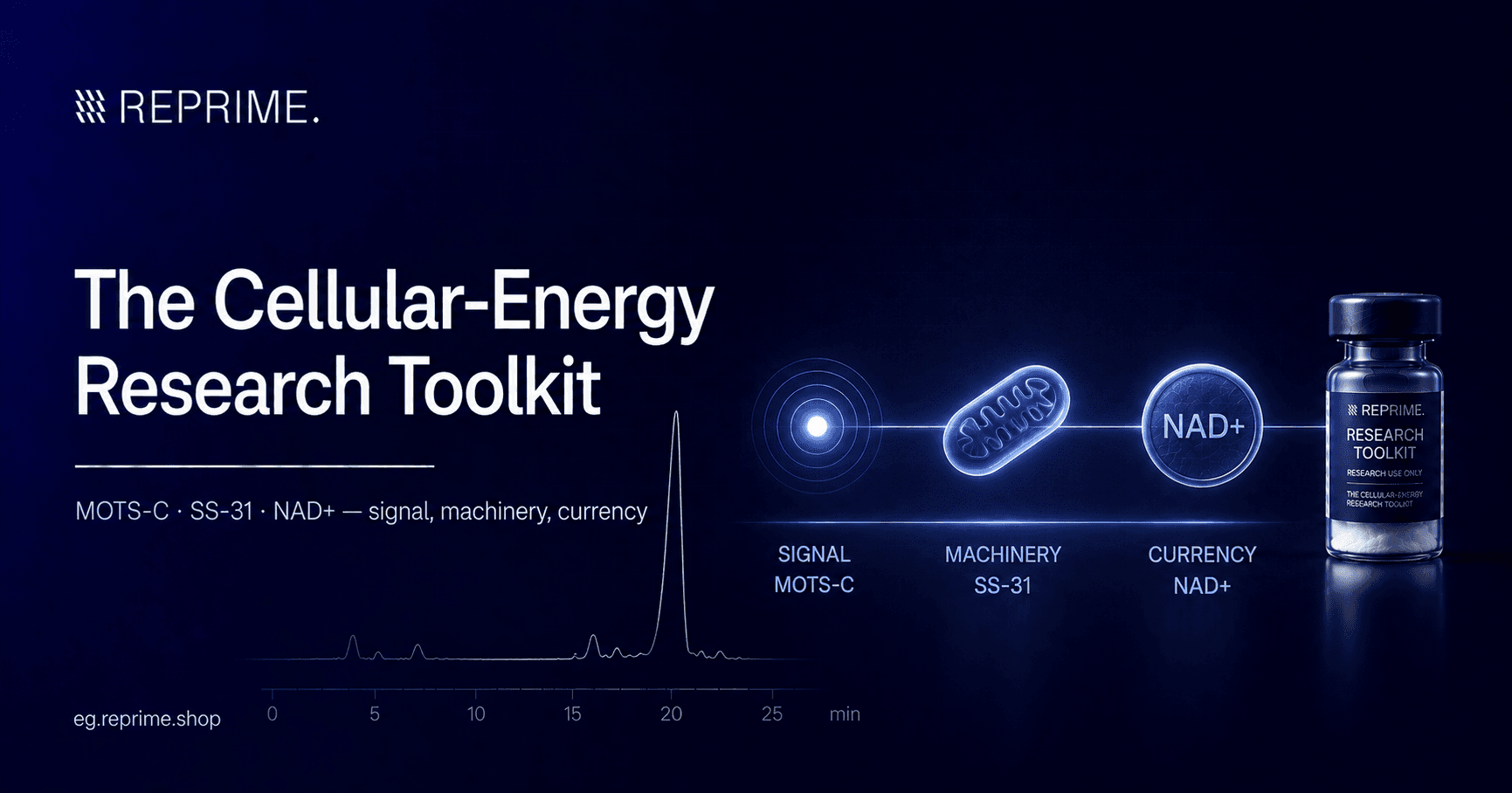
MOTS-C, SS-31, and NAD+ approach mitochondrial research from three different directions — a guide to choosing the right probe for the question.
Mitochondrial and cellular-energetics research runs on three very different kinds of tool, and the REPRIME catalogue now carries one of each: a mitochondrially-encoded signalling peptide, a membrane-targeted synthetic peptide, and the metabolic coenzyme itself. Choosing between them is really choosing what question a protocol is asking.
Three probes, three directions
- MOTS-C is the signal: a 16-residue peptide encoded inside the mitochondrial genome, studied for mitochondria-to-nucleus communication and energy-sensing pathways. Use it when the question is about what the mitochondrion says to the cell.
- SS-31 is the visitor: an aromatic-cationic tetrapeptide that concentrates in the inner mitochondrial membrane and binds cardiolipin. Use it when the question is about the organelle's machinery itself — membrane integrity, respiratory efficiency, oxidative stress at source.
- NAD+ is the currency: the redox coenzyme that energy metabolism spends and signalling enzymes consume. Use it when the question is about the metabolic state the other two operate in.
How they differ
| Tool | What it is | Where it acts | Typical question |
|---|---|---|---|
| MOTS-C | mtDNA-encoded peptide | Signalling pathways (AMPK axis) | What is the mitochondrion signalling? |
| SS-31 | Engineered tetrapeptide | Inner mitochondrial membrane | How is the machinery performing? |
| NAD+ | Coenzyme (not a peptide) | Cell-wide redox and enzyme substrate | What is the energetic state? |
Why the trio matters together
The most interesting energetics questions cross those levels: a signalling readout means little without the metabolic state, and a membrane intervention is interpreted against both. Protocols increasingly use these tools in combination precisely because each reports on a level the others cannot see. That makes consistency of material the quiet prerequisite — one under-documented input and the cross-level comparison loses its footing, which is why every batch here carries the same published documentation.
Working with the toolkit
All three ship lyophilized with batch-level HPLC verification, public COAs, and first-scan verification codes: MOTS-C in 20 mg and 40 mg vials, SS-31 at 20 mg, and NAD+ at laboratory-scale 1000 mg. The usual handling disciplines apply — cold storage, reconstitution close to use. Research use only.
Frequently asked questions
What is the difference between MOTS-C and SS-31?
Direction of travel: MOTS-C is a mitochondrially-encoded peptide studied as an outbound signal from the organelle, while SS-31 is an engineered peptide that travels into the mitochondrial membrane to act there.
Why is NAD+ included with the peptide probes?
Because energetics protocols read peptide-probe results against the cell's metabolic state, and NAD+ — the central redox coenzyme — is both that state's marker and a research material in its own right.
Can the three tools be used in one research programme?
That is their natural use: each reports on a different level (signal, machinery, metabolic state), so combined designs see what single-tool designs cannot.