
Education
What Is NAD+?
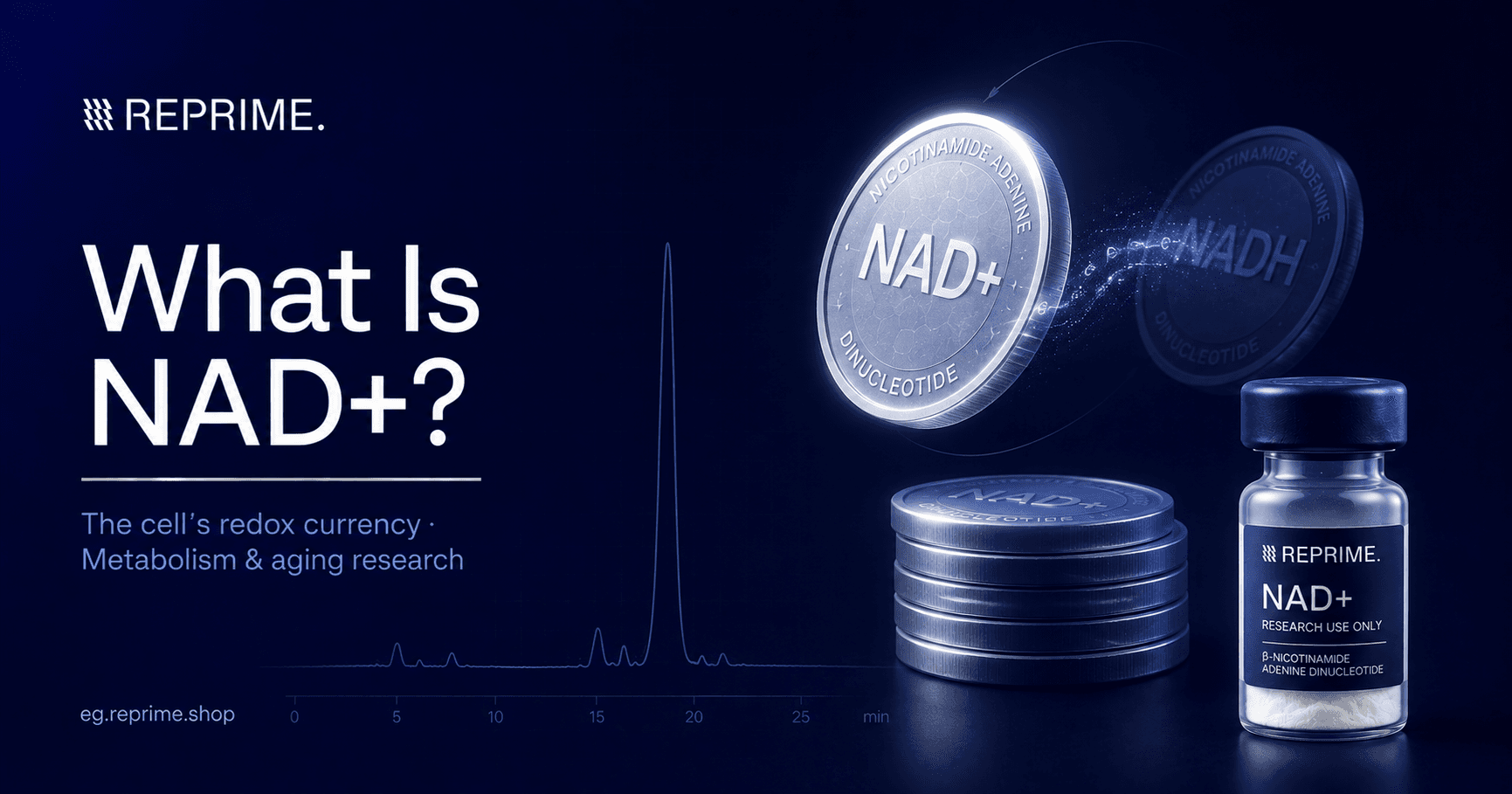
The central redox coenzyme of cellular metabolism — what NAD+ actually is, why it anchors aging research, and what research-grade supply means.
NAD+ — nicotinamide adenine dinucleotide — is not a peptide. It is the central redox coenzyme of cellular metabolism: the electron carrier of energy production and the substrate that sirtuins and PARP enzymes consume to do their work. It earns its place in this catalogue because so much peptide-adjacent research runs on it.
What is NAD+?
Every cell maintains a pool of NAD+ cycling between oxidised and reduced forms as metabolism runs. Beyond that redox role, NAD+ is consumed — used up — by signalling enzymes, which is why cellular NAD+ levels decline under stress and with age. That decline is one of the most-studied phenomena in aging and cellular-energetics research, and the reason NAD+ sits alongside probes like SS-31 and MOTS-C in energetics work — the cellular-energy toolkit guide maps how the three divide the territory.
What researchers study it for
Directly, NAD+ is the reference material for redox assays, enzymology, and metabolic flux studies — the input everything downstream depends on. Indirectly, it is the measured variable in a decade of work on NAD+ decline and restoration. Both uses demand material whose identity and purity are documented, and whose storage discipline is respected — coenzymes degrade like peptides do.
Working with research-grade NAD+
REPRIME supplies NAD+ as a lyophilized 1000 mg vial — laboratory scale, not sample scale — HPLC-verified per batch with a public COA and verification code. See the NAD+ product page. Research use only.
Frequently asked questions
Is NAD+ a peptide?
No — NAD+ is a coenzyme, a dinucleotide built from nicotinamide and adenine. It appears in this catalogue because cellular-energetics research uses it alongside the peptide probes.
Why is NAD+ so prominent in aging research?
Because cellular NAD+ levels decline with age and stress, and the enzymes that consume it (sirtuins, PARPs) sit at the centre of metabolic and repair signalling.
How is research-grade NAD+ supplied?
As a lyophilized 1000 mg vial with batch-level HPLC verification, a public COA, and a verification code — see the product page.