
Science
MOTS-C: The Mitochondrial-Derived Peptide
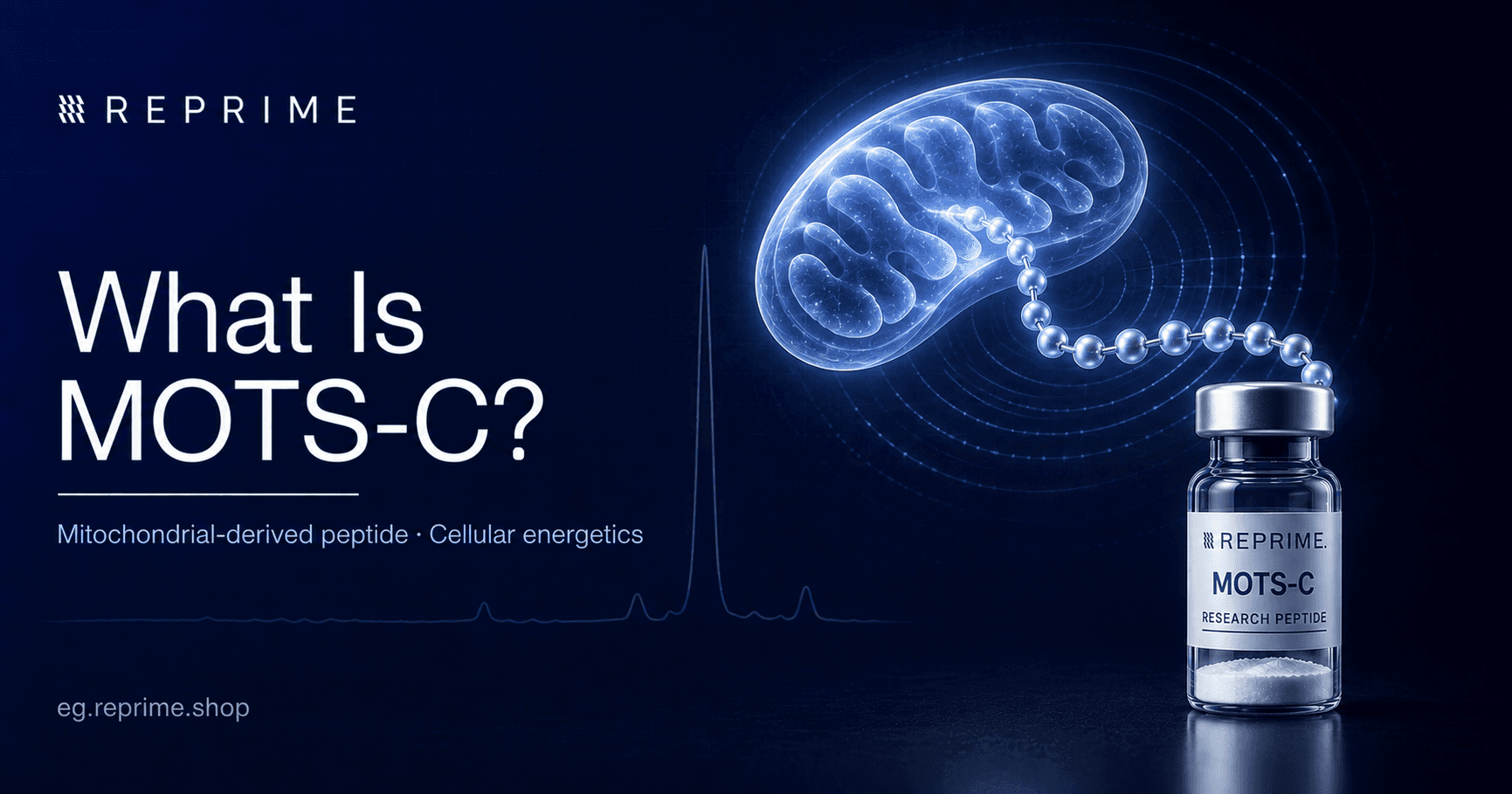
One of the few research peptides whose template lives inside the mitochondrion itself — what that means, and why MOTS-C has driven a decade of research into cellular energetics.
MOTS-C is one of the most structurally unusual peptides in contemporary research because it isn't encoded in nuclear DNA. It originates from a small open reading frame within the mitochondrial 12S rRNA gene, first characterized by Lee et al. in 2015 (see References). A peptide whose template lives inside the organelle it appears to signal back to — that single feature has driven a decade of research into how the mitochondrion and the nucleus communicate.
A 16-amino-acid window into cellular energetics
MOTS-C is short — only 16 amino acids. Its compactness and the unusually small open reading frame it derives from are part of what makes it interesting: research peptides this short are typically structural fragments, not full functional signals. Studies in cellular metabolism, mitochondrial homeostasis, and exercise biology have used MOTS-C extensively as a probe for the AMPK pathway and related energy-sensing axes.
Why researchers use the synthetic form
The native peptide is produced at low concentrations in vivo and is difficult to isolate at research-useful purity. Synthetic MOTS-C from solid-phase peptide synthesis, identity-confirmed by mass spectrometry and purity-verified by HPLC, gives investigators a reproducible reagent — same sequence, same purity, same batch-to-batch behavior. REPRIME's MOTS-C is identity- and purity-verified per batch, with the documents published openly on the product page.
The 40 mg vial
40 mg is a substantial vial — enough for extended protocols when stored at -20°C lyophilized. Reconstitution should be done close to use; working solutions should be refrigerated and used within the period specified on the COA — see the peptide storage guidelines.
A note on positioning
MOTS-C is sometimes lumped together with 'longevity peptides' in marketing copy elsewhere (how the longevity field actually frames metabolic research). REPRIME's positioning is narrower and more honest: this is a research-grade tool for cellular-energetics studies. We don't make health claims, we don't recommend protocols, and we don't suggest dosages. What we stand behind is the COA, the HPLC report, and the verification code printed on the package insert.
Verification
Each package contains a unique code. Verify it on first scan to confirm authenticity.