
Science
The Melanocortin Research Family
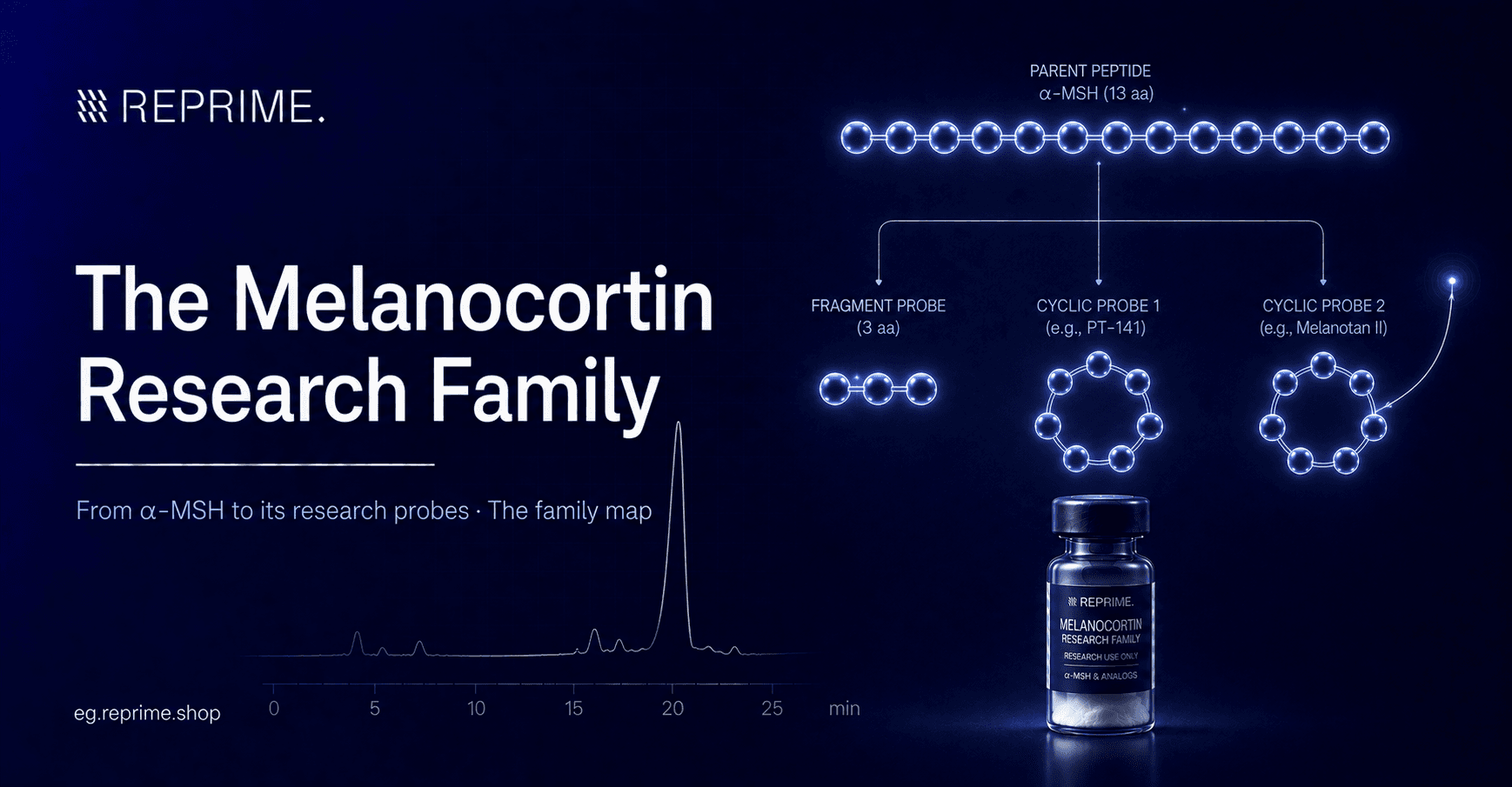
From α-MSH to KPV, Melanotan II, and PT-141 — how one thirteen-residue hormone spawned a family of research probes at every scale.
Few hormones have been taken apart and rebuilt as productively as alpha-melanocyte-stimulating hormone. From one fragile thirteen-residue parent, research chemistry produced a minimal fragment, a stabilised broad agonist, and a central-pathway specialist — and the REPRIME catalogue carries all three. This guide maps the family.
The parent: α-MSH
α-MSH is a thirteen-residue product of the pro-opiomelanocortin (POMC) system, acting through the melanocortin receptor family — five related receptors whose duties range from pigmentation (MC1R) to central energy-balance signalling (MC4R). The hormone itself is a poor laboratory tool: it degrades in minutes. Everything interesting in this family comes from engineering around that weakness.
Three probes at three scales
- KPV — the minimal fragment: α-MSH's final three residues, studied for the anti-inflammatory signalling that tracks with the C-terminus, without the broader receptor footprint. Subtraction as design.
- Melanotan II — the stabilised agonist: a cyclic analog whose lactam bridge locks the active conformation, giving broad, durable melanocortin agonism and the role of reference compound in the family's comparison tables.
- PT-141 — the specialist: Melanotan II's derivative, studied at the central MC3/MC4 axis, with a formal clinical history its relatives lack. The PT-141 vs Melanotan II comparison covers that fork in detail.
Choosing within the family
| Probe | Scale | Use when the question is… |
|---|---|---|
| KPV | 3-residue fragment | The C-terminal signal, isolated from receptor breadth |
| Melanotan II | Full cyclic analog | Broad receptor engagement; the benchmark condition |
| PT-141 | Modified derivative | Central MC3/MC4-axis signalling |
Together they let a protocol walk the whole scale — fragment, parent-analog, specialist — inside one structural family, which is exactly how receptor-pharmacology comparisons are built.
Working with the family
All three ship lyophilized in 10 mg vials with batch HPLC verification, public COAs, and first-scan codes: KPV, Melanotan II, and PT-141. Being small engineered peptides, they store and reconstitute predictably. Research use only.
Frequently asked questions
What are melanocortin peptides?
Peptides acting on the melanocortin receptor family (MC1R–MC5R) — in research practice, α-MSH and the probes derived from it, including KPV, Melanotan II, and PT-141.
Why do researchers use analogs instead of α-MSH itself?
Because native α-MSH degrades within minutes. Fragments and cyclic analogs keep the signalling of interest while surviving long enough for real protocols.
Which member should a protocol start with?
It depends on the question: KPV isolates the C-terminal fragment's signal, Melanotan II provides the broad-agonist benchmark, and PT-141 targets the central MC3/MC4 axis.