
Education
What Is ARA-290?
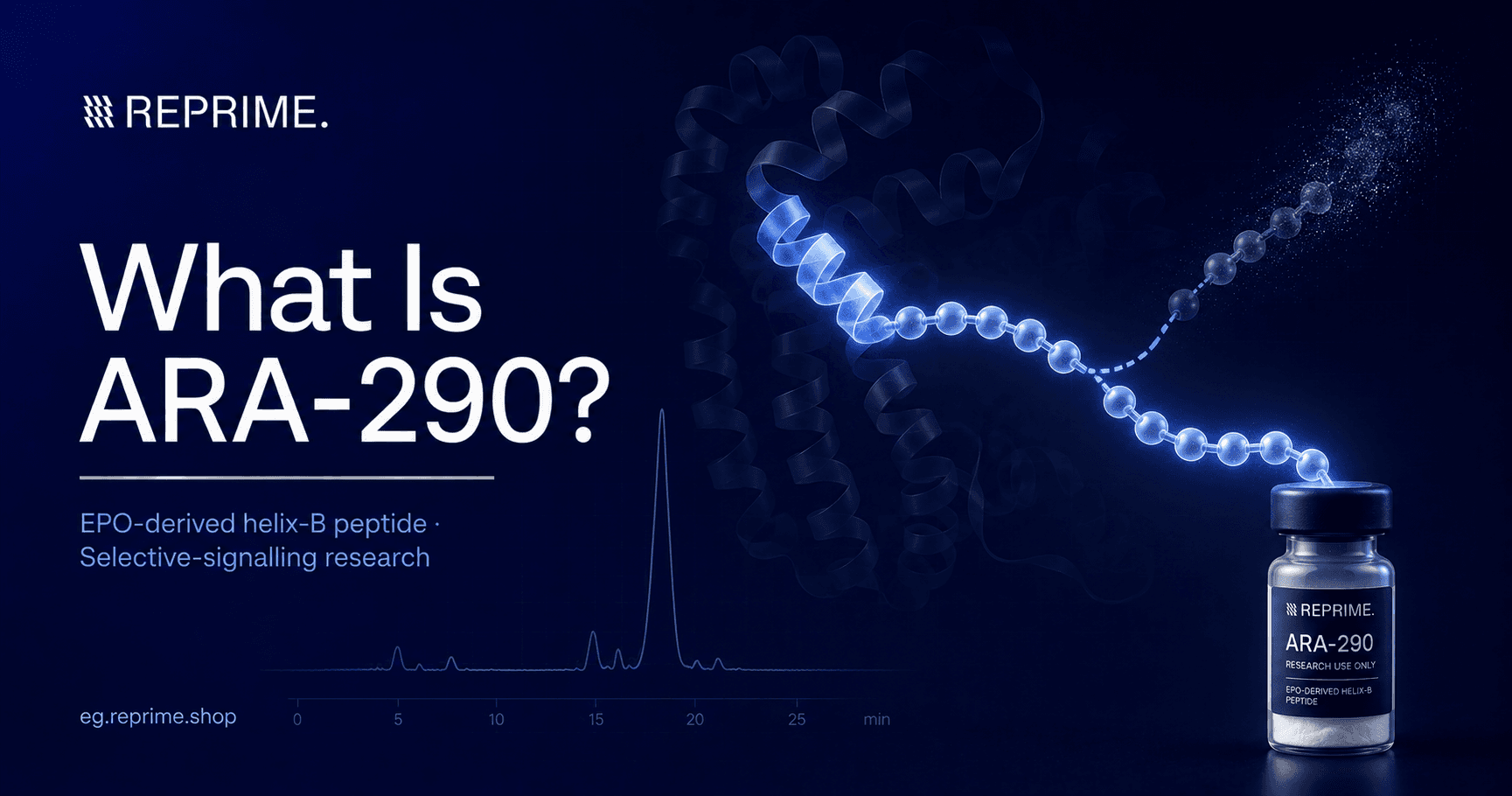
The EPO-derived helix-B peptide (cibinetide) — how it separates tissue-protective signalling from blood-cell effects, and what researchers use it for.
ARA-290, also known as cibinetide, is an eleven-residue peptide derived from the helix-B surface of erythropoietin (EPO). It was designed around a single sharp idea: keep EPO's tissue-protective signalling, discard its blood-cell-stimulating activity.
What is ARA-290?
Erythropoietin does two very different jobs — it drives red-blood-cell production, and it signals tissue protection through what researchers call the innate repair receptor. ARA-290 copies only the surface of the molecule associated with the second job. The result is a short peptide that engages repair-pathway signalling without the hematopoietic activity that makes full EPO a confounded research tool.
What researchers study it for
ARA-290 built its literature in neuropathy and tissue-protection models, where the ability to separate repair signalling from erythropoiesis is exactly the experimental control the parent hormone cannot offer. For protocol designers it is a lesson in engineered selectivity — and a reminder that what a purity figure can and cannot establish matters most when a molecule's entire value is its specificity. Identity evidence per batch belongs on the Certificate of Analysis.
Working with research-grade ARA-290
REPRIME supplies ARA-290 as a lyophilized 30 mg vial — generous capacity for extended protocols — with batch-level HPLC verification, a public COA, and a first-scan verification code. See the ARA-290 product page. Research use only.
Frequently asked questions
What is ARA-290?
An 11-residue peptide (cibinetide) derived from erythropoietin's helix-B surface, designed to engage tissue-protective signalling without EPO's blood-cell effects.
Why not just use EPO in research?
Because EPO's erythropoietic activity confounds tissue-protection experiments. ARA-290 isolates the repair-signalling surface, giving cleaner attribution.
How is research-grade ARA-290 supplied?
As a lyophilized 30 mg vial, HPLC-verified with a batch COA and verification code — see the product page.